Quick answer
There is no single right age for a hair transplant. What decides suitability is not your age but whether your hair loss has settled into a pattern a surgeon can plan around, and whether your donor area can fund that plan for the rest of your life.
Most surgeons are cautious about operating in the very early twenties, and that caution has nothing to do with maturity. Hair loss still moving quickly hides its own end point, and a hairline designed around an unfinished pattern can look wrong fifteen years later.
At the other end of the range, age rarely rules anyone out. Men in their fifties, sixties and seventies are often straightforward candidates because the pattern has already declared itself, and the assessment shifts from predicting the future to checking general health and donor supply.
If you are considering surgery in Hyderabad, the useful first step is a scalp examination rather than a birthday. Our hair transplant treatment guide explains the techniques, the assessment and recovery. This article deals only with timing: when surgery makes sense and when waiting is better.
Does age alone decide if you can have a hair transplant?
Pattern hair loss is a process, not an event. It starts at different ages, moves at different speeds and settles at different end points. Two men of twenty-four can be in entirely different situations: one with a hairline unchanged in four years, the other shedding rapidly.
So a surgeon assessing you is not really asking how old you are. The questions behind the consultation are these.
- Is the diagnosis clear, and is this pattern hair loss?
- Has the rate of loss slowed enough for the pattern to be read?
- Will the donor area support today's plan and a future one?
- Do your expectations match what moving your own hair can achieve?
- Are you well enough for a long procedure under local anaesthesia?
Age influences every one of those answers, which is why it feels decisive. It is only a proxy: a twenty-eight-year-old with an unstable, diffuse pattern may be a poorer candidate than a fifty-five-year-old with a dense donor rim.
| Age band | Usual planning question | Typical first step |
|---|---|---|
| Under 20 | Pattern has not declared itself | Diagnosis and medical review only |
| Early twenties | Loss often still moving fast | Medical treatment, photographic review |
| Late twenties to thirties | Pattern usually readable | Design that keeps donor hair in reserve |
| Forties and fifties | Pattern largely settled | Priority areas treated first |
| Sixty and over | Health matters more than age | Fitness check, often shorter sessions |
What does stable hair loss actually mean?
Stabilising does not mean the loss has stopped for good; in most men it never completely stops. It means the rate of change has slowed, the shape is recognisable, and the surgeon can judge where it is heading.
What does the surgeon examine?
An assessment starts with history: when the thinning began, how fast it moved, episodes of heavy shedding, family pattern, past illness, medicines and any thyroid or iron problems. Photographs from three to five years ago are often the most informative item.
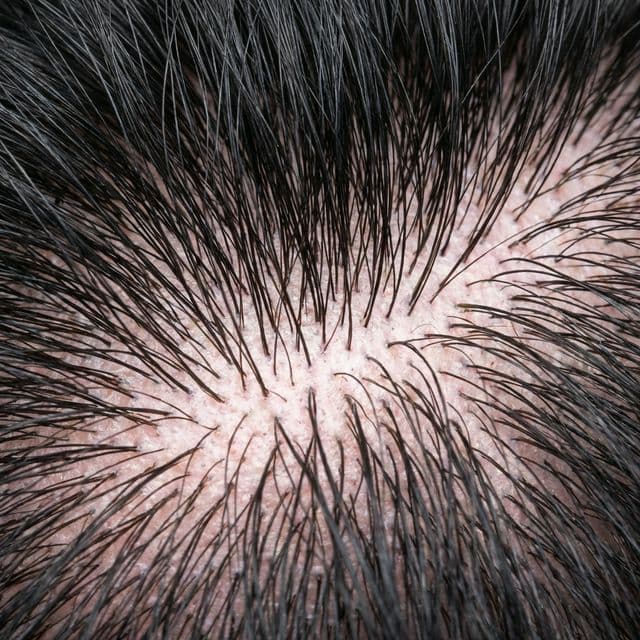
The scalp is then examined, usually under magnification, for hair calibre. Miniaturisation, where hairs become finer and shorter before they are lost, is the clearest sign that an area is still in decline. Miniaturised hair in the zone you want treated is likely to go, with or without grafts around it.
The donor area gets the same scrutiny, because miniaturisation at the back and sides suggests the loss is not a simple pattern and that moving hair forward would relocate the problem.
When is it better to watch and review?
Where the picture is unclear, the usual approach is standardised photographs and a review after six to twelve months, alongside medical treatment. Where much of the hair in the target zone is miniaturised, many surgeons prefer to wait and reassess; a threshold of around fifteen percent is often quoted, though it is a guide rather than a rule.
Sudden loss, patchy bald areas, scaling, itching, pain or scarring need a diagnosis before any cosmetic planning. Surgery is not a substitute for finding out what is happening.
How do Norwood stage and family history guide the plan?
Reading the direction of travel
The Norwood scale describes the stages of male pattern hair loss, from a slightly receded mature hairline through frontal recession and crown thinning to loss of the whole top of the scalp.
Its more useful function is directional: the surgeon compares where you are now with how long it took to get here. Loss that began in the late teens and reached frontal and crown thinning by twenty-three suggests a pattern that will keep advancing. Loss that appeared at thirty and has barely moved by thirty-six suggests something more contained.
Crown involvement in a young man is treated with caution. The crown can expand for decades, and filling it early commits donor hair to an area that will need more later. Many surgeons prioritise the front in younger patients and keep the crown under review, a choice set out in more depth in whether the hairline or the crown should be treated first.
What can family history tell you?
Pattern hair loss is inherited through many genes and from both sides of the family, so the old idea of looking only at your mother's father is incomplete. Look at your father, uncles, older brothers and both grandfathers, and note when each began losing hair and how far it went by sixty.
That gives a plausible range, not a forecast. Family history sits alongside your examination as a planning input, and people do depart from their family pattern in both directions.
The donor area is a lifetime budget
One idea explains most of the caution around age: the area needing coverage can grow throughout life, but the donor area does not. It is fixed, does not regenerate, and every graft taken from it is spent permanently.
The safe donor zone in an average adult yields only a few thousand follicular units over a lifetime, and the figure varies widely between individuals. Once that budget is used, no further hair can be created; it can only be moved from what is left.
Timing is therefore a spending decision. A man who spends a large share of his supply at twenty-three on a dense, low hairline may reach thirty-five with a band of thinning behind it and little in reserve. The same supply, spent later and spread with the whole scalp in mind, can cover a much larger eventual pattern.
This is why a plan for a young patient is often designed for the head he will have at forty-five rather than the head in front of the surgeon. A slightly higher hairline, moderate density, natural temple position and grafts held back all keep the budget flexible.
Staging follows the same logic: treatment split across procedures years apart lets the plan respond to what the loss actually does. A staged plan is not a sign of failure.
Why does a low hairline at twenty-two become a problem at forty?
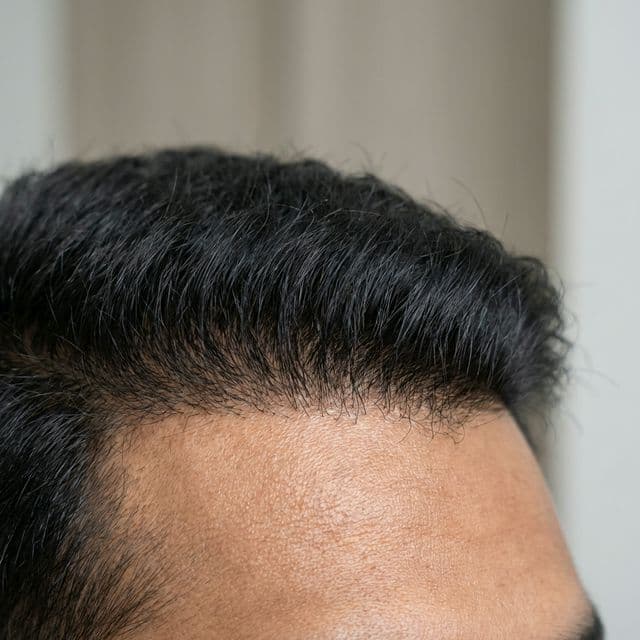
The hairline you had at sixteen is not the one an adult man keeps. Most men develop a mature hairline in their late teens or twenties, sitting slightly higher with softened recession at the temples. That change is normal and is not in itself balding.
A hairline placed at the juvenile position looks convincing at twenty-two, when the hair behind it is still full. The difficulty arrives later. Transplanted hair keeps the behaviour of the area it came from, so that hairline stays where it was put while the native hair behind it thins. The result can be an isolated band at the front with a thin zone behind it, which reads as unnatural in a way plain recession does not.
There is a second cost. A low, wide hairline spends a disproportionate share of donor hair on a small strip. When the same patient needs crown coverage at forty, that supply has already gone into a hairline that no longer suits his face.
Reversing this is difficult. Transplanted hair can be thinned or removed and a front edge softened, but that consumes further donor hair and rarely restores a neutral starting point. It is far easier to lower a conservative hairline later than to raise an aggressive one.
A hairline drawn with age in mind sits higher than a young patient first wants, with a soft, irregular front edge and temples left where nature put them. It should look right at thirty, at forty and at sixty, not only in photographs taken next year.
When is it better to wait and treat medically first?
Waiting is a clinical decision, not a refusal. It is usually advised when the pattern is still moving quickly, when the loss is diffuse without a clear shape, when the donor area looks thin, when the diagnosis is uncertain, or the scalp is inflamed or scarred.
During that period, medical therapy does the work surgery cannot. Surgery redistributes hair; it does nothing to protect what you still have. Medical treatment aims to slow the loss of native hair, and for many men it is the more important half of the plan. Several categories exist, taken by mouth or applied to the scalp, along with clinic-based options. Which suits you, if any, is a decision for a clinician who has examined you, and you should not start or stop any medicine on the basis of an article. If you are weighing injectable options against surgery, how PRP compares with a hair transplant is a useful next read.
Fixed dates complicate the decision. It is common to arrive at a consultation with a wedding or a move abroad in mind and to want surgery brought forward. A date is a good reason to start the assessment early, not a reason to operate on an unstable pattern, and a rushed decision rarely delivers what the date demanded.
Waiting also suits cases where expectations rather than the scalp are the concern; someone hoping to return to teenage density is unlikely to be satisfied by surgery. Most men who do have surgery continue medical treatment afterwards, because untransplanted hair carries on behaving as it always did.
Is there an upper age limit for a hair transplant?
There is no fixed upper age limit. Men in their sixties and seventies commonly have hair transplants, and in some respects are easier to plan for than men in their twenties. The pattern has fully declared itself, the donor rim is known, and goals tend to be practical.
What replaces the question of stability is fitness for the procedure, which is usually performed under local anaesthesia, sometimes with sedation, and can involve several hours in one position. A general health assessment before surgery typically covers:
- heart disease, blood pressure control and any history of stroke
- diabetes and its control, which affects healing and infection risk
- bleeding tendencies, and any blood-thinning medicines or supplements
- kidney, liver and thyroid function, and any cause of reduced immunity
- your ability to stay comfortable through a long session
- smoking, which affects blood supply to grafts and healing skin
None of these automatically prevents surgery. They change how it is planned, how long a session runs and whether it is staged. Some medicines need adjusting around the procedure, a decision for the prescribing doctor rather than the clinic alone.
Donor hair also changes with age. Density often falls, shafts become finer and skin is less elastic, which affects harvesting. Greying can help, because less contrast between hair and scalp makes moderate density look fuller. Realistic aims centre on framing the face and softening an abrupt bald outline rather than restoring youthful thickness.
Healing can be slower with age, and complications, including infection, poor graft survival, numbness and scarring, remain possible at any age. Only an in-person assessment by a qualified plastic surgeon can tell you whether the trade-off makes sense for you.
Frequently asked questions
Can a twenty-one-year-old have a hair transplant?
It is possible, but most surgeons will want a strong reason. At twenty-one the pattern is often still declaring itself, and grafts placed now are committed permanently. The usual route is diagnosis, medical treatment and photographic review, with surgery reconsidered once the picture is steadier.
Does hair loss that starts at eighteen change the plan?
Usually yes, in a conservative direction. Early onset often, though not always, signals a pattern that will become extensive, so plans favour a higher hairline, moderate density, front-first priorities and a larger donor reserve. It does not rule surgery out; the design should assume more loss is coming.
Is fifty-five or sixty too old for a hair transplant?
No. Age alone excludes nobody, and results in this group are often satisfying because the pattern is settled and goals realistic. The assessment covers general health, medicines, tolerance of a long session, donor density and skin quality. Sessions may be shorter or staged, and healing can take a little longer.
Does age affect how long transplanted hair lasts?
Transplanted follicles keep the characteristics of the area they came from, so they tend to persist whatever age they were moved at. What changes is everything around them. Untransplanted hair keeps thinning, so a result can look different over the years even when the grafts are doing well.
Does waiting a year make the final result worse?
Rarely. You may lose some further native hair, but the grafts you would have used are still there, and you gain real information about how your pattern behaves. Waiting is usually paired with medical treatment, which limits further loss. Deciding too early is the harder mistake to undo.
Practical takeaway
The right age for a hair transplant is whichever age your loss becomes readable, your donor supply can fund a lifetime plan and your expectations match what moving your own hair can achieve. For some men that is twenty-six and for others thirty-eight, and for many the honest answer at a first consultation is not yet. A surgeon who declines to operate today and offers a review in a year is protecting the result you will want at forty.
If you are working out where you sit, get the diagnosis confirmed, ask what the proposed plan assumes about your future pattern, and ask how much donor hair it leaves in reserve. The hair transplant treatment guide sets out how the procedure and the assessment work, but timing is individual: only an in-person examination by a qualified plastic surgeon, with your scalp, donor area and history in front of them, can tell you whether now is the right time for you.
References
- National Center for Biotechnology Information: Hair Transplantation, StatPearls
- National Center for Biotechnology Information: Androgenetic Alopecia, StatPearls
- International Society of Hair Restoration Surgery: Early Hair Loss, The Young Patient
- International Society of Hair Restoration Surgery: A Guide to Hair Transplantation After Age 50
- British Association of Aesthetic Plastic Surgeons: Hair Transplant Surgery