Quick answer
Hair transplants look natural when the design is right, and a poorly planned one stays obvious for the rest of your life. The difference is rarely the number of grafts. It is design: where the front edge sits, how irregular it is, which grafts go at the very front, the angle and direction each graft points in, and how density is graded from front to back.
Modern surgery moves hair in the small natural groupings it already grows in, usually one to four hairs together, which removed the tufted look older punch grafting produced. What it did not remove is the need for judgement. Two surgeons can move the same grafts from the same donor area and produce results that look entirely different from a metre away.
Natural also means natural for you. A design that suits a face at twenty-five may look strange at fifty, because hair loss continues behind a transplanted hairline while the transplanted hair stays.
If you are considering surgery in Hyderabad, start with a scalp assessment rather than a graft number. Our hair transplant treatment guide covers the techniques, candidacy and recovery. This article stays with one question: what makes a result blend in or stand out, and which decisions cannot be reversed.
What makes a hair transplant look obvious?
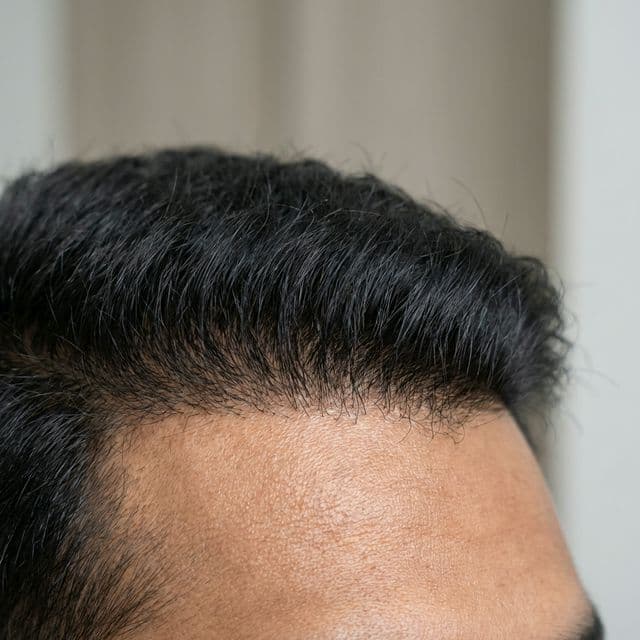
Most well-planned results go unnoticed, even at conversational distance. What people see in a poor result is usually not thinness but a pattern the eye reads as wrong: a hard straight edge where forehead meets hair, clusters of several hairs in visible rows, shafts leaving the scalp at the wrong angle so they stand away from the hair around them, or a front edge drawn too low for the face beneath it.
Density is the thing most patients worry about and it is rarely the thing that gives a result away. A moderately dense area with a soft, uneven front edge and correct angulation reads as hair. A very dense area with a straight edge and grafts pointing the wrong way reads as surgery, however many follicles went into it.
Contrast between hair and scalp matters too. Coarse dark hair over lighter scalp, common in many Indian patients, shows spacing and direction more clearly than fine or light hair does. Wavy hair is more forgiving, because it hides the point at which each shaft leaves the skin. Straight, thick, dark hair is the least forgiving combination, so its design needs more care, not less.
| Design feature | Reads as hair | Reads as surgery |
|---|---|---|
| Shape of the front edge | Uneven, softly scalloped | Straight, even line |
| Grafts at the leading edge | Single hairs only | Two and three-hair clusters |
| Angle at the hairline | Sharp, hair lies forwards | Upright, hair stands away |
| Density across the zone | Graded from front to back | Uniform from the first row |
| Height of the hairline | At or above mature position | Low, juvenile position |
| Temple points | Fine hairs, flat and tapered | Coarse, full, set forwards |
Why did old punch grafts and plugs look unnatural?
For decades, hair restoration relied on round punches that removed a plug of scalp containing ten or more hairs and moved it across whole. The hairs in a plug grew as one clump, so the scalp carried rows of tufts with bare skin between them, an appearance patients described as doll's hair or corn rows. The skin often healed with a raised, cobblestoned texture, and the front edge was usually placed as a straight line low on the forehead.
None of that came from the idea of moving hair. It came from moving hair in the wrong unit, at the wrong spacing and in the wrong shape.
How is a natural hairline designed?
A natural hairline is not a line. Look closely at a full head of hair and the front is a soft, ragged band a few millimetres deep, with occasional single hairs ahead of the rest, thickening gradually into the denser hair behind. Surgeons plan this as a transition zone in front of a more defined zone, and most of the work of looking natural happens there.
Irregularity, not symmetry
A hairline that is perfectly even and perfectly symmetrical sounds like the ideal and looks artificial. Natural front edges carry two kinds of irregularity. Macro-irregularity is the gentle scalloping along the length of the hairline, small peaks and setbacks rather than one smooth arc. Micro-irregularity is the scatter of individual hairs at the leading edge, some sitting ahead of the general line, so the eye never finds a border to lock on to. Deliberate asymmetry belongs here too, because faces are not symmetrical and neither are hairlines.
Where should the hairline sit on the face?
The design usually starts from three marks: a mid-frontal point in the centre and the two frontotemporal angles where the front edge turns back towards the temples. In men the mid-frontal point is commonly planned somewhere in the region of seven to ten centimetres above the glabella, the area between the eyebrows, though that is a reference range rather than a rule, varying with facial height and proportion.
Women's hairlines tend to sit lower, with a rounder and less recessed shape, while men's frontotemporal angles are sharper. Softening or filling that angle is a classic design error, because the recession behind it often continues and a rounded corner that once looked full can end up as an isolated island of hair.
Why do single-hair grafts go at the front?
The leading edge of a transplanted hairline should contain single-hair grafts and nothing else. A graft carrying two or three hairs at the very front produces a visible cluster from one point, and a row of those clusters is exactly what the eye recognises as a transplant. Fine, soft single hairs are usually chosen for this row where the donor area offers them.
Behind that first row the plan builds up in stages: two-hair grafts, then three-hair and larger grafts further back, where they add bulk without being individually visible. This is the density gradient, and it copies the way hair naturally becomes denser and coarser away from the forehead. A hairline built at uniform density from the first millimetre looks like a hedge, even when the hairs point correctly.
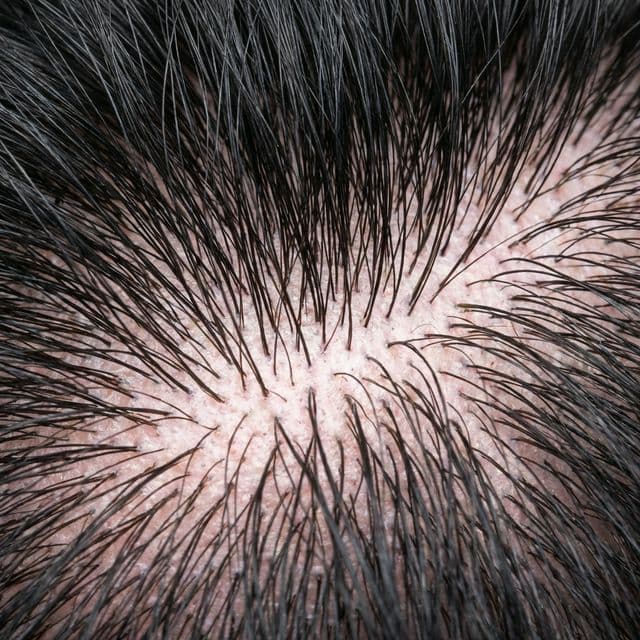
The gradient also has to run towards whatever native hair remains, so grafts placed among thinning hair blend into it rather than stop abruptly. The same applies at the crown, where hair spirals around a whorl and needs distributing into that pattern rather than packing into a solid patch.
Placement pattern matters as much as graft count. Grafts set out in even rows create a grid that catches the light in a repeating way, while staggered placement produces the randomness of ordinary hair.
Why do graft angle and direction matter?
Angle and direction are two separate things, and both are fixed when the recipient site is made, before a single graft is placed. Angle is how steeply hair leaves the scalp. Direction is which way it points. Getting either wrong is one of the most visible faults in hair restoration and one of the hardest to put right.
Natural hair does not stand up out of the scalp. It emerges at a slant that varies by region:
- At the frontal hairline it leaves the skin at a sharp forward angle, commonly described as around fifteen to twenty degrees to the scalp surface.
- Over the temples it points downwards and slightly backwards, lying almost flat against the skin.
- Across the mid-scalp it flows forwards and usually a little to one side.
- At the crown it spirals around a whorl, changing direction continuously.
Grafts placed too upright stand away from the scalp, catch the light differently from the hair around them and cannot be combed flat with any product. Grafts aimed in the wrong direction fight the native hair beside them and open partings as the hair grows longer, which is why some results look acceptable at three months and wrong at twelve.
Temple points and the sides of the frame
Temple points are the small triangular wedges of hair in front of the ears that connect the sideburn area to the hairline. They frame the face, and losing them makes the forehead look broader even when the front hairline is intact.
Rebuilding them is delicate. The hairs there are among the finest on the scalp, lie almost flat, and point down and back in a tight, consistent direction, so only single-hair grafts are suitable. Temple points built too far forward, too full, or with hair that is too coarse are conspicuous in profile and age poorly as the hairline recedes.
What is an age-appropriate hairline?
Many people arrive wanting the hairline from a school photograph. A juvenile hairline sits low and runs almost straight across, and by the late twenties or thirties most men have moved to a mature hairline that sits a little higher with defined recession at the corners. Rebuilding the juvenile version on an adult face is one of the commonest reasons a technically clean transplant still looks wrong.
There is a second reason to design conservatively. Hair loss is progressive, and a transplant does not stop the native hair behind the graft line from thinning. A very low, very dense hairline consumes a large share of a finite donor supply now and leaves less for later, which is why how many grafts a plan actually needs belongs in the design conversation. If loss continues behind it, the transplanted band can be left standing in front of thinner scalp, which is far more noticeable than a slightly higher hairline would have been.
An age-appropriate design is one that will still make sense at forty-five and at sixty, not only at twenty-five. That usually means a front edge at or above the mature position, frontotemporal corners left open rather than filled, and donor supply budgeted across a lifetime rather than one operation. Whether medical therapy has a role alongside surgery is a separate decision for a qualified clinician who has examined your scalp.
How do you judge a clinic's before and after photographs?
Photographs are the main evidence most patients ever see, and they are easy to stage without any editing. A change of lighting, haircut, hair length or camera angle can create most of the apparent improvement in a pair. Look for what is harder to arrange:
- Before and after images shot from the same angle and distance, under the same light, with the hair styled the same way.
- A front-on view with the hair combed back off the forehead rather than brought forward over the hairline.
- A close-up of the hairline itself, not only a wide shot of the whole head.
- A top-down view, which is where crown work and density gaps show.
- Hair that is wet or cut short in at least one image, since both remove the concealment that length and styling provide.
- A stated interval since surgery, because the appearance keeps changing through the first year.
- Short video, which is harder to stage than a still because the hair moves and the light changes.
In a close-up of a natural result the front edge is uneven, with a few single hairs ahead of the rest and no straight row. Hairs lie in one consistent direction rather than some standing up, and the skin between them looks like ordinary scalp, without pitting or pale round marks.
What cannot be corrected later?
Several design choices are permanent, which is why they deserve more attention than the graft number.
Donor hair is finite and does not regenerate. Grafts spent on a hairline placed too low are gone, and they are the same grafts that would have covered the mid-scalp or crown ten years later. Hair can be removed from a hairline set too low, but that trades one problem for another and does not return the follicles to the donor area.
Angle and direction are decided when the recipient site is made, and healed grafts cannot be re-aimed. Correcting them means extracting the misplaced grafts and re-implanting them, which spends donor supply, adds scarring and takes another year to show. Revision has limits of its own, set out in what a failed hair transplant repair can fix. Recipient sites made too large, too close together or too deep can leave pitting or a cobblestoned texture that is difficult to reverse.
Surgery also carries the usual risks, including bleeding, infection, folliculitis, altered sensation, poor graft take and visible thinning of the donor area, and these are possible even when the design is sound. No article can tell you what your own scalp will do. Only an in-person assessment by a qualified plastic surgeon, with an examination of your donor area and a diagnosis of the cause of your hair loss, can give you a personal answer.
Frequently asked questions
Will people be able to tell in the months after surgery?
The recipient area is red and crusted in the first week or two, and the transplanted hairs then shed before regrowing, so there is a period when the area can look thinner than before surgery. A short overall haircut makes this easier to carry. Plan the timing around work and family events rather than expecting to hide it.
Are women's hairlines designed differently from men's?
Yes. Female hairlines usually sit lower, run in a rounder shape with less recession at the corners, and often carry fine downy hairs along the front edge. Female pattern loss also tends to be diffuse rather than patterned, so diagnosis and suitability matter before any design is drawn.
Can beard or body hair be used at the hairline?
Beard and body hair are sometimes used to add bulk when scalp donor supply is limited, but they differ from scalp hair in calibre, texture, curl and growth cycle. Coarse beard hair at the front edge is conspicuous, so where it is used at all it is kept well behind the hairline, with scalp single hairs reserved for the leading edge.
Do transplanted hairs behave like the rest of my hair?
Once established, transplanted hair keeps the characteristics of the donor area it came from. It grows continuously, needs cutting, greys with age and can be washed, oiled, dyed and styled normally. It does not require special products. It also does not protect the untransplanted hair around it, which can continue to thin on its own timetable.
Can I bring a photograph of the hairline I want?
Bringing reference images is useful, because it shows the surgeon what you have in mind and opens a realistic conversation. What cannot be promised is another person's hairline, since their facial proportions, hair calibre, donor density and loss pattern differ from yours. Expect the discussion to move towards a shape that suits your own face.
Practical takeaway
A natural hair transplant is mostly decided before any instrument touches the scalp. The hairline is planned as an irregular zone rather than a line, the front edge is built from single hairs, density is graded backwards, every recipient site follows the angle and direction hair naturally takes in that part of the scalp, and the design is placed where it will still look right in twenty years. Graft numbers matter, but they are the last of these, not the first.
When you review a clinic's work in Hyderabad or anywhere else, look at close-up hairline photographs under consistent lighting rather than wide shots, and ask specifically how the front edge, the frontotemporal angles and the temple points will be designed for your face. Our hair transplant treatment guide sets out the techniques and what recovery involves, but a design that suits you can only come from an in-person assessment by a qualified plastic surgeon who has examined your scalp and donor area.
References
- National Center for Biotechnology Information: Hair Transplantation, StatPearls
- American Society of Plastic Surgeons: Hair Transplantation and Restoration
- Seminars in Plastic Surgery: Revision of the Unfavorable Result in Hair Transplantation
- Indian Journal of Plastic Surgery: Hair transplantation surgery
- Cureus: Comprehensive Review on Hair Loss and Restorative Techniques