Quick answer
You can still go bald after a hair transplant, but the hair that goes is almost never the hair that was transplanted. Grafts taken from the safe donor zone at the back and sides of the scalp normally keep growing where they are placed. What continues is the thinning of your native hair, the hair you were born with, sitting around and behind the transplanted area.
The reason is a principle called donor dominance. A follicle tends to behave according to where it came from rather than where it is put. Move a follicle that was resistant to pattern hair loss, and it usually stays resistant in its new position. Move nothing into the areas that are still thinning, and those areas carry on thinning.
So the useful question is not whether the transplant will fall out. It is what the rest of your scalp is likely to look like in ten or fifteen years, and whether the design you agree to today will still make sense by then. That is a planning question, and it belongs in the consultation rather than in a surprise ten years later.
Our hair transplant treatment guide explains the techniques, candidacy and recovery in more detail. This article deals only with long-term stability: why native loss continues, how it can spoil an otherwise good operation, and what a surgeon can do at the planning stage to reduce that risk.
What does donor dominance actually mean?
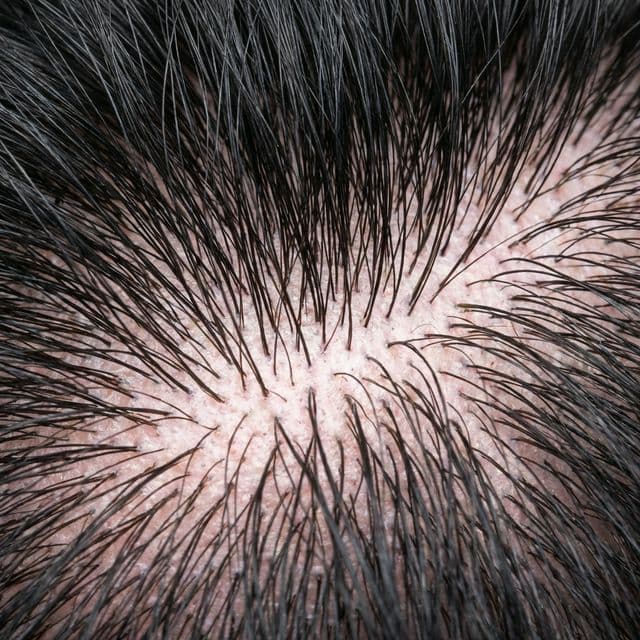
Pattern hair loss is not random. In most men, and in many women, it follows a fairly predictable map. Follicles across the top, front and crown of the scalp carry an inherited sensitivity to circulating androgens. In sensitive follicles, each growth cycle produces a slightly shorter, finer, less pigmented hair than the last. This gradual weakening is called miniaturisation. Eventually it gives no coverage at all, even though the follicle may still be present.
The hair band at the back of the head and low on the sides usually does not carry that same sensitivity. Surgeons refer to this region as the safe donor zone.
Donor dominance means those follicles keep their own character when they are moved. A resistant follicle transplanted into a bald frontal area generally grows, cycles and persists as it would have done at the back of the head, largely unbothered by the process that is thinning its new neighbours.
Two honest caveats belong with this. First, safe is a probability rather than a guarantee. The exact boundaries of the stable zone differ between individuals, they can shift as a person ages, and in some patterns of loss the donor band itself is affected. Second, donor dominance says nothing whatsoever about the hair that was never moved. It protects the grafts. It does not protect the rest of your head.
| Hair | Usual long-term behaviour | Reason |
|---|---|---|
| Grafts from the safe donor zone | Usually keeps growing where placed | Donor dominance |
| Native hair inside the treated area | May carry on thinning | Still androgen sensitive |
| Native hair behind or around the grafts | May carry on thinning | Unchanged by surgery |
| The donor zone itself | Usually stable, thins slowly with age | Low androgen sensitivity |
What is an isolated island hairline?
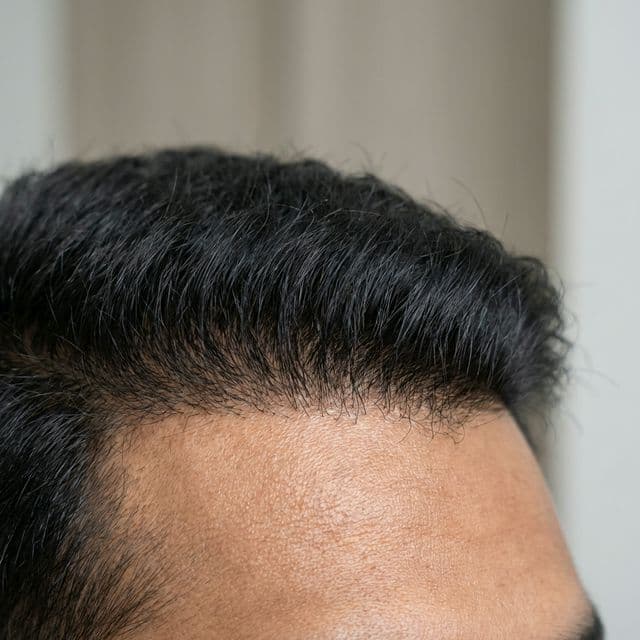
Picture a man in his early thirties with a receding frontal hairline and reasonable density behind it. He has a transplant, the hairline is rebuilt, and for a few years the result looks good. Over the following decade the native hair sitting behind that new hairline continues to miniaturise, because nothing was ever done to change its behaviour. The transplanted band at the front carries on growing exactly as designed.
The outcome is a dense strip of hair at the front with thin or bare scalp behind it. In the trade this is sometimes called an isolated island or a floating hairline, and it looks distinctly odd, because no natural pattern of hair loss produces it. The grafts did not fail. Every one of them may have survived. The plan simply did not anticipate what the untreated hair would do.
A similar problem occurs at the back of the scalp. If grafts are placed into a thinning crown while the ring of native hair surrounding it is still weakening, the treated centre can end up encircled by a widening bald band. Surgeons sometimes describe the appearance as a doughnut. It is one of the reasons many are reluctant to work on the crown early in a young patient with an unclear pattern.
A gap can also open between a transplanted frontal zone and the hair further back, so that two separate areas of coverage sit with a visibly thin strip between them. Once that happens, the fix requires more grafts to blend the boundary, and those grafts come out of a donor supply that has already been drawn on once. Correction is often possible in experienced hands, but it is always more expensive in donor hair than getting the plan right the first time. Our guide to revising and repairing a previous hair transplant sets out what can realistically be corrected.
Why does surgery during unstable hair loss age badly?
Hair loss that has settled into a recognisable pattern is very different from hair loss that is still moving quickly. When the eventual pattern is not yet apparent, surgery is aiming at a target that is still shifting.
There is a second, less obvious problem. When grafts are placed into an area that still contains native hair, the density you see at nine or twelve months is the sum of the new grafts plus whatever native hair was already there. If that native hair is miniaturising, it will disappear over the following years, and the visible density will fall even though every graft is alive and well. The early photographs then look better than the long-term reality, which is deeply frustrating for a patient who was told the result was permanent.
Some features suggest a pattern that has not settled and deserves observation before any operation is planned:
- Noticeable change in the last twelve to twenty-four months rather than a slow drift over many years
- Thinning that appears to involve the back and sides as well as the top
- Widespread miniaturisation seen on close scalp examination rather than clearly demarcated bald areas
- Sudden shedding, patchy loss, scaling, itching or scalp soreness, all of which need a medical diagnosis first
- A family history of extensive loss beginning at a young age
If a surgeon suggests waiting, or starting with medical assessment and treatment while the pattern is watched, that is not obstruction. It is usually the advice that protects your donor supply and your long-term appearance.
How should a hairline be designed for future loss?
A design that looks excellent in the first year and a design that still looks right in the twentieth year are not always the same design. The difference is whether future loss was allowed for.
A hairline placed low, straight and dense reads as young at first and as artificial later, because a natural hairline recedes and softens with age. A slightly higher, more mature hairline with a softer, less regular leading edge tends to sit comfortably on a face at forty and at sixty, and it uses fewer grafts, leaving more in reserve.
Temple points matter for the same reason: rebuilding them fully in a young patient spends grafts on an area that would have receded anyway.
Transitions matter too. If the transplanted zone ends in an abrupt border where dense placement meets untreated native hair, that border becomes conspicuous the moment the native side weakens. A graded transition, with density tapering rather than stopping, tends to age more gracefully because the change is gradual either way.
The front of the scalp is usually prioritised over the crown when donor supply is limited, because it frames the face and because the crown can enlarge unpredictably. None of this is a fixed rule, and your surgeon should be willing to explain the trade-offs in terms of your own pattern, age and family history.
How much donor hair should you keep in reserve?
Your donor area is a finite account. It does not regenerate, and every graft withdrawn is unavailable for the future. The recipient area, by contrast, can grow over your lifetime. Planning that treats the first operation as the whole story tends to run out of resources exactly when they are most needed.
Budgeting means deciding, in advance, roughly how much of the donor supply you are willing to commit now and how much you want held back for a second procedure later. It is a conversation about priorities: which area matters most to you, and what you would want covered if loss progresses further than expected.
Staging follows naturally from that. A staged plan treats the priority area first, then reviews after a year or more, once the transplanted hair has matured and the behaviour of the native hair is clearer. The second stage can then respond to what actually happened rather than to a prediction. Staging is not a sign that the first procedure underperformed, and it is not upselling when it is set out honestly before the first operation rather than introduced afterwards.
What can be done for the native hair?
Surgery relocates hair. It does nothing to change the behaviour of the follicles that were left in place. That is why ongoing medical management of native hair is usually discussed alongside surgery rather than as an alternative to it.
In broad terms, medical therapy for pattern hair loss aims to slow miniaturisation and, in some people, to partially reverse it, so that the hair around and behind the transplanted zone holds its ground for longer. There are topical and oral options, and various in-clinic and energy-based approaches are also promoted. Their suitability differs considerably from person to person, and effects generally last only while treatment continues. If your hair is thinning all over rather than receding in a pattern, our comparison of PRP, medication and surgery for diffuse hair loss covers that decision in more depth.
Only a qualified clinician who has examined your scalp can decide whether any of this applies to you. Do not start, stop or change any medicine on the basis of an article or a friend's experience, and tell your surgeon about everything you already take. All of these treatments carry possible side effects, as does surgery itself, and complications are possible in any procedure.
If you cannot take medical treatment, or you decide you would rather not, that is a legitimate choice, but it should change the surgical plan. A patient whose native hair is not being supported at all should generally be offered a more conservative design, with a higher hairline and more donor hair held in reserve, because more future loss has to be assumed.
What should you ask your surgeon before booking?
The quality of this conversation tells you a great deal about the quality of the plan. Useful questions include:
- Which parts of my current coverage are native hair that is still thinning, and which parts are stable?
- What pattern of loss do you expect me to reach eventually, and what is that judgement based on?
- If I lose all the native hair you expect me to lose, what will this design look like then?
- How much of my donor supply will this operation use, and how much remains for later?
- Would you recommend waiting, or treating medically first, and why?
- If I have no further treatment for my native hair, would you change the design?
- What would a second stage involve, and when would you review me?
What you want is a surgeon who answers in terms of your scalp, your age, your family pattern and a specific long-term picture. Be more cautious with an answer that only describes the immediate result, quotes a package with no assessment, or dismisses future loss as something to worry about later. If you are comparing clinics in Hyderabad, compare them on this reasoning rather than on graft counts or before-and-after galleries, which almost always show the first year rather than the fifteenth.
Frequently asked questions
Do transplanted hairs ever thin with age?
Transplanted hairs are not immortal. They age as the donor hair would have aged, which for many people means some gradual thinning of calibre over decades. This is different from pattern loss and is usually far slower and less complete. If a transplanted area thins markedly within a few years, it more often suggests the grafts were taken from a zone that was not truly stable.
Will my result look worse if I stop medical treatment later?
The transplanted grafts should be unaffected. What may change is the native hair that the treatment was supporting. If that hair had been maintained by treatment and then resumes thinning, overall density in and around the treated area can fall, and any contrast between transplanted and untreated zones may become more visible. Discuss stopping with the clinician who prescribed it rather than stopping on your own.
Does this apply to women as well?
Yes, and the planning is often harder. Female pattern loss is frequently diffuse, involving a wide area including regions that would be used as donor sites in men. That makes candidate selection more selective and makes a stable donor zone less certain. A careful diagnostic assessment matters even more before considering surgery.
I had a transplant elsewhere and a gap has appeared behind the hairline. Can it be fixed?
Often it can be improved. Options may include grafting the area behind the transplanted zone to blend the boundary, redistributing poorly placed grafts, and addressing the native hair medically so that further widening is slowed. What is realistic depends on how much donor hair remains, so an assessment of the donor area comes first.
Is there any procedure that stops future hair loss altogether?
No. No transplant halts pattern hair loss, because it does not alter the follicles that were left behind. Surgery addresses hair that has already gone. Anything that slows further loss is medical rather than surgical, works only while it is continued, and does not suit everyone. Any clinic promising a permanent end to hair loss is overstating what is possible.
Practical takeaway
Going bald after a hair transplant is rarely a story about failed grafts. It is usually a story about a plan that accounted for the hair being moved but not for the hair being left behind. Donor dominance is real and dependable, and it is also narrow: it protects what is transplanted and nothing else. A result that still looks natural in twenty years comes from a conservative design, a realistic view of your likely eventual pattern, a donor supply that has not been spent all at once, and an honest position on managing the native hair.
Before you book anything, ask to see the long-term version of the plan and not just the first-year version. Our hair transplant treatment guide sets out how the procedure works and who tends to be a suitable candidate, but no article can tell you where your own stable donor zone lies or how far your pattern is likely to progress. Only an in-person assessment by a qualified plastic surgeon, with proper examination of your scalp and donor area, can give you a personal answer.
References
- National Center for Biotechnology Information: Hair Transplantation, StatPearls
- National Center for Biotechnology Information: Androgenetic Alopecia, StatPearls
- American Academy of Dermatology: A hair transplant can give you permanent, natural-looking results
- International Society of Hair Restoration Surgery: Revision and Repair of Previous Hair Transplants
- PubMed Central: Hair restoration surgery: challenges and solutions