The short answer
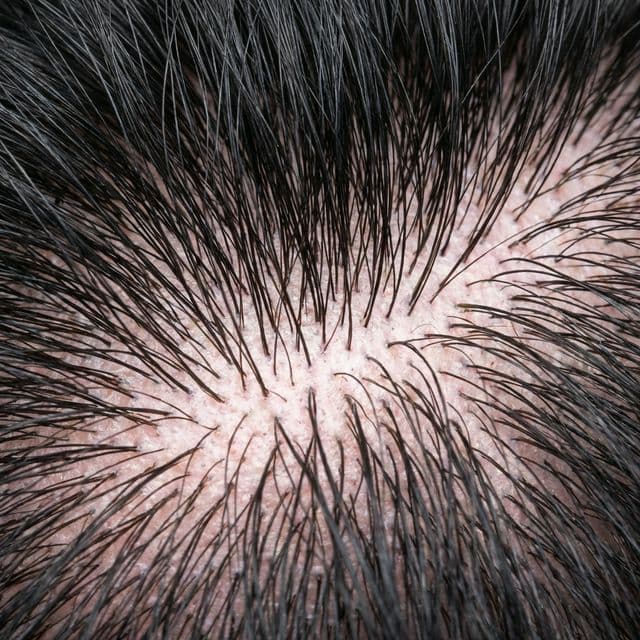
Diffuse hair loss means density is reducing across a broad area rather than forming one sharply defined bald patch. It can affect the front, mid-scalp, crown, or much of the top of the head. The important point is that the visible thinning is a pattern, not a diagnosis. The best treatment depends on whether follicles are miniaturising, shedding temporarily, inflamed, scarred, or simply being viewed under harsh light.
For many patients, medication is the first step when thinning is active or the cause is uncertain. PRP may be useful as an adjunct for selected patients with miniaturising but still-living follicles. A hair transplant becomes more relevant when areas have stable, significant loss and the donor area can safely support redistribution. These options are not always competitors: a carefully planned treatment may use medical therapy to stabilise loss, PRP to support native hair, and FUE transplantation to restore areas that no longer respond sufficiently.
Why diffuse thinning is different from a simple receding hairline
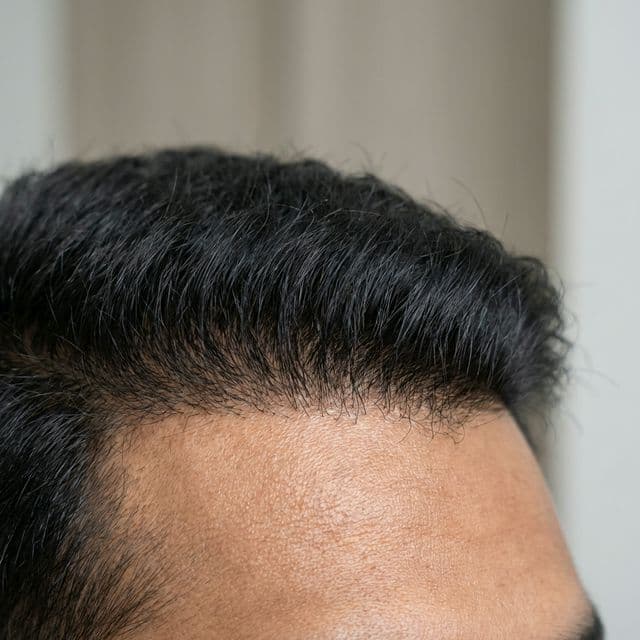
A receding hairline usually has a relatively clear boundary between hair-bearing and hair-losing skin. Diffuse thinning is more subtle. You may still have hair everywhere, but each strand becomes finer, the scalp shows through under overhead light, and styling no longer creates the same coverage. Some people notice it first in photographs, during a haircut, or when their hair is wet.
Diffuse thinning also makes planning more demanding. Transplanting into an area that still contains many vulnerable native hairs can create a good short-term visual improvement but leave the overall pattern unstable if the underlying loss continues. A surgeon must decide which follicles are likely to recover, which can be protected, and which areas genuinely need grafts.
Common patterns a consultation should separate
- Androgenetic alopecia, often called male or female pattern hair loss, where follicles gradually miniaturise in a predictable distribution.
- Acute or chronic telogen effluvium, where increased shedding follows illness, stress, weight change, nutritional problems, or another trigger.
- Diffuse alopecia areata, which may produce patchy or widespread loss and needs a different medical assessment.
- Traction, chemical, or heat-related damage, especially when the hairline or parting is repeatedly stressed.
- Scalp inflammation or infection, where redness, scaling, pain, pustules, or scarring can change the treatment plan.
The same person can have more than one factor. That is why a package promising a fixed graft number after a quick photograph is not a reliable substitute for diagnosis.
What should happen before choosing a treatment
A useful consultation is not just a discussion about technique. It should document the pattern, the duration of loss, family history, previous treatments, donor density, scalp health, and your goals. Standardised photographs from the front, both sides, top, and back make future comparison much more meaningful than memory.
Depending on your history and examination, the clinician may discuss blood tests or referral for medical evaluation. These may be relevant when shedding is sudden, diffuse, associated with fatigue or other symptoms, or occurring in a woman with menstrual, hormonal, or postpartum changes. Tests are not automatically required for everyone, but they should be considered when the history points beyond straightforward pattern loss.
Ask for a diagnosis in plain language. You should understand whether the goal is to reduce shedding, thicken miniaturised hairs, replace lost coverage, treat a scalp condition, or combine several goals. You should also understand what will happen if you do nothing for six to twelve months.
Medication: when it is usually the first move
Medication is often considered when the loss is active, the thinning is widespread, or many native follicles are still present. Its role is to slow miniaturisation, reduce shedding, and preserve or improve the hair that you already have. It does not create an unlimited supply of new follicles, and results depend on the diagnosis, consistency, and individual response.
A doctor may discuss topical or oral options based on your sex, age, medical history, blood pressure, reproductive plans, other medicines, and risk tolerance. The correct choice is a clinical decision, not a shopping-list recommendation. Some medicines are unsuitable in pregnancy or require specific counselling. Do not start, stop, or combine prescription treatments based only on an online package or a friend’s experience.
What to expect from medical treatment
- Improvement is gradual. Early shedding can fluctuate, and a few weeks is usually too soon to judge success.
- The target may be stabilisation rather than dramatic regrowth. Preventing further loss can be a meaningful result.
- Treatment often needs ongoing use to maintain its benefit, depending on the medication and diagnosis.
- Progress should be checked with consistent photographs and clinical review, not daily mirror inspections.
If the hair loss is sudden, painful, itchy, scaly, or associated with smooth patches, medication for pattern loss alone may miss the real problem. Diagnosis comes first.
PRP: where it may fit in a diffuse-thinning plan
Platelet-rich plasma, or PRP, uses a processed sample of your own blood that is injected into selected areas of the scalp. It is intended to support the local environment around hair follicles. In practice, PRP is most useful to discuss when there are miniaturised but viable follicles and the patient understands that it is a supportive treatment rather than a replacement for a missing donor supply.
PRP may be offered as a standalone treatment for early or moderate thinning, or as an adjunct alongside medication or a transplant plan. The protocol varies between clinics: preparation, platelet concentration, injection technique, number of sessions, and maintenance schedules are not identical. A credible discussion should explain what outcome is being measured and over what time period.
PRP is less likely to solve an advanced, stable bald area where follicles are no longer producing useful hair. It also cannot correct an unrealistic hairline design or compensate for an inadequate donor area. You should be cautious of claims that promise guaranteed density, permanent results from a single session, or a universal response.
Hair transplant: when redistribution makes sense
A transplant moves your own follicles from a donor area—usually the back and sides—to areas with insufficient coverage. FUE removes follicular units individually; the recipient sites are then planned and the grafts are placed to create a natural distribution. The key resource is not the number of grafts a clinic is willing to quote. It is the lifetime donor supply that can be harvested without visible over-depletion.
Diffuse thinning can be suitable for transplant when the pattern is sufficiently understood, the loss is reasonably stable or medically managed, the donor area is healthy, and the expected gain justifies the available grafts. The operation may target the hairline, frontal zone, mid-scalp, crown, or a staged combination. Treating every thin area in one sitting is not automatically the safest or most aesthetic choice.
Situations where a transplant may need to wait
- The shedding is recent, rapidly worsening, or not yet diagnosed.
- The proposed hairline is too low for the patient’s age and long-term donor reserve.
- The donor area is itself thin or miniaturising.
- There is active scalp inflammation, infection, or scarring.
- The patient expects adolescent density rather than improved framing and coverage.
- The treatment plan depends on a large graft number without explaining long-term donor protection.
A good plan includes a conservative hairline, realistic density priorities, and a strategy for future loss. It also explains whether the surgeon or a technician will perform each important step, how grafts are counted, and what follow-up is included.
PRP, medication, or transplant: a practical decision guide
Choose medical evaluation and likely medication-first management when the thinning is recent, the shedding is active, the pattern is unclear, or a large amount of native hair remains. The immediate objective is to identify and control the cause. A later transplant can still be considered if stabilisation does not restore enough coverage.
Discuss PRP when you have early-to-moderate miniaturisation, want a non-surgical adjunct, or need a plan to support native hair around a transplant. Ask exactly how the clinic will track response and whether PRP is being recommended for a defined reason or simply added to a package.
Discuss transplant when the loss is established, the target area has inadequate density, the donor area is strong enough, and your expectations are realistic. It is a surgery, even when it is marketed as a quick procedure. Recovery, temporary shedding, graft protection, and the possibility of future sessions should be part of the conversation.
For many diffuse-thinning patients, the most sensible sequence is: diagnose the pattern, stabilise active loss, reassess with photographs, then decide whether graft redistribution is needed. This sequence may feel slower, but it protects you from spending on a procedure before you know what problem you are treating.
Cost and quote comparison in Hyderabad
The price of diffuse hair loss treatment in Hyderabad depends on the treatment selected and the complexity of the case. A medication plan and a PRP course are priced differently from a transplant. For surgery, cost may be influenced by graft count, donor difficulty, recipient-area complexity, surgeon involvement, facility, anaesthesia or clinical support, aftercare, and whether future planning is included.
Do not compare two quotes using only a per-graft number. Ask whether the quote states the estimated graft range, who will perform extraction and placement, what medicines and follow-up are included, and what happens if the final graft count changes. For PRP, ask how many sessions are proposed, what preparation method is used, what review is included, and whether maintenance is expected.
A lower quote is not automatically poor, and a higher quote is not automatically better. The relevant comparison is the clarity of the diagnosis, the safety of the plan, the experience of the operating surgeon, the quality of counselling, and the realism of the expected result.
Recovery and results: set the right timeline
Medication and PRP are judged over months, not days. A transplant also has a long timeline: the transplanted hairs may shed temporarily, early growth is uneven, and visible improvement usually develops gradually. The hairline may look better before the crown, and the final assessment should allow enough time for maturation.
After surgery, follow the clinic’s instructions for washing, sleeping position, activity, sun exposure, and medication. Contact the clinic promptly for increasing pain, spreading redness, fever, pus, or other symptoms that concern you. Avoid judging the result by a single photograph taken under different lighting. Use the same angles and intervals that were used during assessment.
The goal is not to make the scalp look artificially dense from one angle. It is to create a durable, natural improvement that fits your age, facial proportions, donor limitations, and future hair-loss pattern.
Questions to ask at your Hyderabad consultation
- What is the most likely diagnosis, and what else needs to be ruled out?
- Is my loss active, stable, or mixed?
- Which areas still have miniaturised native hairs that should be protected?
- What would happen if I waited six months before considering surgery?
- How many grafts are safe from my donor area over my lifetime?
- Who will design the hairline and perform extraction, site creation, and placement?
- What result is realistic at six and twelve months?
- What is included in the written quote, and what is not?
- What is the plan if I continue to lose native hair?
- How will follow-up photographs and clinical reviews be scheduled?
A consultation should leave you with clearer choices, not pressure to book immediately.
Frequently Asked Questions
Can diffuse hair loss be treated with a hair transplant?
Sometimes. A transplant may help when the pattern is established, the donor area is adequate, and the native hair loss is stable or medically managed. It is not a universal solution for active shedding or an undiagnosed scalp condition.
Is PRP better than a hair transplant for diffuse thinning?
They solve different problems. PRP may support follicles that are still alive but weak; a transplant redistributes follicles into areas with inadequate coverage. The better option depends on the diagnosis, severity, donor area, and treatment goal. Some patients use both as part of a staged plan.
How long should I try medication before deciding on a transplant?
There is no single timeline for everyone. The clinician may recommend a defined period long enough to assess stabilisation and response, often with standardised photographs. Sudden or medically suspicious shedding should be evaluated promptly rather than delayed for a cosmetic trial.
Will a transplant stop future hair loss?
No. Transplanted follicles are intended to provide durable coverage, but your native hair can continue to thin. A long-term plan may include medical treatment, monitoring, and conservative use of donor grafts.
Can women with diffuse thinning have a hair transplant?
Some women are candidates, but the cause of diffuse thinning must be assessed carefully. The pattern, donor density, hair calibre, scalp health, and underlying medical factors all matter. A transplant should not be used to bypass an evaluation for treatable causes of shedding.
Does a higher graft number guarantee a denser result?
No. Density depends on graft quality, recipient-site planning, hair calibre, angle, survival, donor limitations, and the balance between immediate improvement and future reserve. More grafts can be harmful if the donor area is over-harvested.
Final takeaway
Diffuse hair loss is a treatment-planning problem before it is a technique problem. Start with a diagnosis and photographs, identify whether the loss is active, and protect the hair you still have. Medication may be the right first step; PRP may be a useful adjunct; a hair transplant may be appropriate when stable areas need durable coverage. In Hyderabad, compare clinics by the clarity and safety of the plan—not only by graft count, package price, or the name of a technique.