Quick answer
You do not always need medication after a hair transplant, but for most people it is at least discussed. Surgery moves hair from one part of the scalp to another and does not switch off the process that caused the loss, so the hair you did not transplant carries on along its own path.
That is why medical therapy is a separate decision from surgery. Grafts generally keep growing on their own once settled, because they retain the characteristics of the donor area they came from. Medical therapy, where it is appropriate, is aimed at protecting the native hair around and behind them, which is a different problem with a different answer.
Some patients decide not to take anything. That can be reasonable when it is made with full information, but it changes how the hairline is designed, how much donor hair is held back and how likely a second procedure becomes. It should be a planned decision rather than a silent one.
Our hair transplant treatment guide explains the techniques, candidacy and recovery in more detail. This article covers only the maintenance side: what medical therapy is for, how suitability is decided, where adjunct treatments sit, and how follow-up review works.
What does a hair transplant actually change?
Pattern hair loss is a gradual process in which sensitive follicles produce thinner, shorter and lighter hairs over successive cycles until they produce nothing visible. Surgery does not interrupt that process. It relocates follicles from a region that is usually not sensitive to it into a region that is.
Two things happen on the same scalp at once. The transplanted follicles establish themselves and grow. The native follicles that were already weakening keep weakening. In the first year the grafts are the visible story, which is why a result can look convincing at twelve months and less settled several years later if nothing was done about the background.
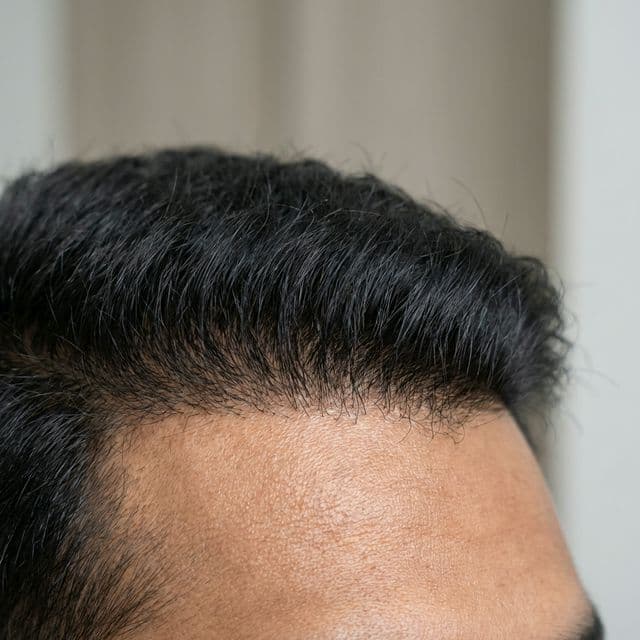
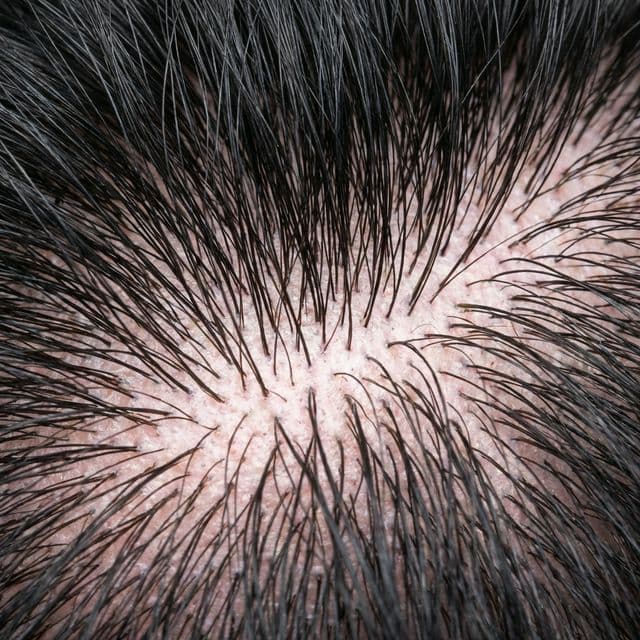
The pattern this produces is recognisable. Density in the treated zone holds up while the area immediately behind it, often the mid-scalp or crown, quietly loses ground. The join between the two becomes more obvious with time, not because the grafts failed but because their surroundings changed.
This is why age and rate of loss matter at the planning stage. Someone in their twenties with active loss has far more change ahead than someone in their fifties whose pattern has settled, so the younger patient has more to gain from a maintenance conversation.
Why does hair loss continue after a transplant?
The native hair is the moving part
A treated scalp a year after surgery carries two populations of hair: the grafts, and whatever native hair was already growing between and behind them. Both contribute to the density you see. Only one is at risk from the underlying process.
If that native hair continues to miniaturise, visible density falls even though every graft is growing normally. Patients often read this as graft failure. It is usually the opposite: the grafts held and the background did not. Medical therapy is aimed at that background, which is why a surgeon may raise it even when you came in asking only about an operation.
Do the transplanted grafts depend on medication?
Generally no. Follicles taken from the stable donor region tend to keep behaving like donor hair after they are moved, and that is the reason the technique works at all. They are not usually dependent on ongoing medical treatment in order to survive.
That is a general tendency rather than a guarantee. Transplanted hair still ages and still cycles, and it can thin gradually over decades as all hair does. Grafts placed at the edge of a zone that later becomes affected may behave less predictably than grafts placed well inside a stable one. The honest summary is that transplanted hair is far more stable than native hair in a thinning area, not that it is permanent in an absolute sense.
It also helps to know what success looks like here. It is usually holding ground rather than dramatic regrowth: a treatment that keeps an area roughly where it was for several years is doing its job, even though nothing photogenic happens.
What kinds of medical therapy are proven?
At a category level, the treatments with the strongest evidence in pattern hair loss fall into two groups. One is applied directly to the scalp. The other is taken by mouth and acts on the hormonal signal that drives the pattern. Going further than that in an article is not useful, because whether either category suits you depends on facts that only a proper history and examination can establish.
Three separate groups of treatment are worth keeping apart.
| Treatment group | What it is aimed at | Typical duration |
|---|---|---|
| Proven medical therapy | Hair that was not transplanted | Long term, if a doctor advises it |
| Adjunct treatments | Support alongside the main plan | Repeat sessions to sustain effect |
| Post-operative medicines | Healing in the days after surgery | A short, defined course |
What does a doctor assess before prescribing?
- whether pattern hair loss is genuinely the diagnosis, or whether something else is contributing to the shedding
- your age, your sex and where you sit in the course of the loss
- other medical conditions, and every regular medicine or supplement you take
- your family plans, since suitability differs at different stages of life
- whether you are realistically willing to continue a long-term treatment, since any benefit depends on continuing it and recedes when it stops
Counselling matters as much as the prescription
A prescription handed over without a conversation is not informed consent. Before any medical therapy is considered, you should be told what it is expected to do, how long it takes before any change is visible, what the recognised side effects are and how commonly they occur, what to do if you notice something, and what happens if the treatment is stopped. You should be given written information, the chance to ask questions and time to think.
Ask for that conversation in plain language. If a treatment is bundled into a surgical package, ask who assessed you for it, and on what grounds. Do not start or stop any prescription medicine on the strength of an article, a video or a friend's experience. That decision belongs to a qualified doctor who has examined you and knows your history.
What if you choose not to take anything?
Many patients decide against medical therapy, and the reasons are usually sensible: concern about side effects, plans to start a family, reluctance to commit to a daily routine for years, or a preference to keep things simple. A responsible clinic records that decision and plans around it rather than arguing with it.
What changes is the surgical plan, not whether surgery is possible.
- the hairline is usually designed more conservatively, so that it still looks appropriate if the surrounding hair thins further
- the frontal area is often prioritised over the crown, because the frame around the face returns more visible value per graft
- more donor hair is deliberately held back in reserve
- staging becomes more likely, and a further procedure is discussed as a probability rather than an outside chance
- the consent conversation sets the expectation that further native loss may occur
None of this is permanent. Some people decline at first, watch what happens over a year or two, and revisit the discussion at a review. Others keep to their original decision and plan around it. What matters is that the surgeon knows which plan is being followed before the hairline is designed, because that design is difficult to undo afterwards.
Adjunct treatments and where the evidence is weaker
Adjuncts sit in a third category, separate from proven medical therapy and from surgery. They are often offered alongside a transplant and deserve a more careful description than they usually get.
Scalp-based injectable therapies
Treatments that involve injecting a preparation derived from your own blood into the scalp are widely offered in India and elsewhere. The published evidence is mixed rather than absent. Studies have reported improvements in density and hair calibre, but preparation methods, concentrations, injection patterns and session intervals vary a great deal between studies and between clinics, which makes findings hard to compare or reproduce. Where benefit occurs, it generally fades without repeat sessions.
A fair way to hold these treatments is as a possible support rather than a substitute for proven medical therapy, and not as a replacement for surgery when the loss is beyond what any non-surgical option can address. The comparison of scalp injection courses against surgery for different degrees of loss sets out which situations suit which approach. If a programme is presented as equivalent to established treatment, ask what that claim rests on.
Low-level light devices
Caps, helmets and combs that deliver low-level light to the scalp are sold for home use and also used in clinics. There is a reasonable body of published work suggesting a modest effect in pattern hair loss, and the treatment is generally well tolerated. The limitations are practical. Devices differ in output and design, study quality varies, adherence over months is often poor, and the reported effect is modest rather than transformative.
None of this is a reason to dismiss adjuncts outright. It is a reason to be told honestly what is known, what is uncertain and what a course is expected to add to your plan before you commit to it.
Which medicines are given around the surgery itself?
A separate group of medicines has nothing to do with long-term maintenance. Around the procedure itself, the operating team may prescribe a short course of something for pain, something to limit swelling, and in some cases an antibiotic, depending on the technique, the size of the session and your medical history. These are given for a defined number of days with written instructions, and they are not maintenance therapy.
Take only what your own team has prescribed, in the way they described it. Do not add painkillers, anti-inflammatory tablets or herbal preparations yourself, and do not extend a course because you felt it helped. If something is not working as expected, or you notice an unusual reaction, contact the clinic rather than adjusting the plan yourself.
The reverse conversation belongs before surgery. Tell the team about every regular medicine, supplement, herbal preparation and over-the-counter product you use, including anything affecting blood clotting or blood pressure. Several of these matter for bleeding and healing. Complications after hair transplant surgery are uncommon but possible, and a complete medicine history is one of the simplest things that reduces avoidable risk.
How does follow-up review work?
The first review usually falls within the first week or two and is about healing rather than results. The team checks the recipient area, the donor area, how crusts are clearing and whether there is any sign of infection. Nothing meaningful can be said about growth at that stage.
Reviews then continue across the first year, because transplanted hair follows a slow schedule and there is little to judge early on. If the early shedding phase worries you, read the guide to why grafts shed before they grow and when growth starts so you know what a normal first few months look like. The useful comparison is not whether the scalp looks better than on the day of surgery, since almost everything does. It is whether the untreated areas are holding their density against photographs taken before the operation, in the same lighting and at the same angles. That is what tells you whether the maintenance decision is working, and it is why clinics take standardised photographs rather than casual phone pictures.
The grafted and native areas should be assessed separately, because reading them as one figure hides the change that matters. The donor area is reviewed too, since its condition decides what remains possible later.
After the first year, most people need only an annual review, with an earlier appointment if they notice increased shedding, a change in the parting or any scalp symptom such as pain, scaling or sores. A second procedure is usually discussed only once the first year is complete. Whether you are followed up in Hyderabad or elsewhere, ask at the outset how many reviews are included and who you contact between appointments.
Frequently asked questions
Should medical therapy be discussed before surgery or only afterwards?
Usually before. The assessment that decides whether you are a suitable surgical candidate is the same one that establishes your diagnosis, your rate of loss and whether medical treatment suits you. In younger patients with active or unclear loss, a doctor may want a period of observation before committing to an operation.
Will medical treatment change how quickly transplanted hair grows?
No. Grafts follow their own schedule after surgery and no maintenance treatment speeds that up. Anything prescribed is aimed at the hair around the grafts rather than at the grafts themselves, so judge it by whether the untreated areas keep their density over years, not by how quickly new hair appears.
I take regular medicines for another condition. Does that rule me out?
Not automatically, but it is exactly the information that decides the answer. Existing conditions, current prescriptions, supplements and previous reactions all affect what is suitable. Bring a written list to your consultation rather than recalling it on the spot, and include anything you buy without a prescription.
Are shampoos and supplements a substitute for medical therapy?
Generally no. Cosmetic shampoos can improve how hair looks and feels and can help with scalp conditions, and correcting a nutritional deficiency helps if one is confirmed on testing. Neither addresses the underlying process in pattern hair loss, and taking supplements without a confirmed deficiency is unlikely to help.
Does the same discussion apply to beard or eyebrow transplants?
Not in the same way. Facial hair restoration is planned around a different set of questions, and the hair in those areas is not usually subject to the same pattern process as scalp hair. Maintenance therapy for pattern hair loss is a scalp conversation, and your surgeon should explain what applies to the area being treated.
Practical takeaway
A transplant and a maintenance plan answer two different questions. Surgery deals with the hair that has already gone. Medical therapy, where a doctor judges it appropriate, is about protecting the hair you still have. You can reasonably choose one without the other, but the choice should be made knowingly, with the design built around it, rather than discovered at a review three years later.
If you are weighing this up, take a written list of your medicines to your consultation and ask for the reasoning behind anything that is recommended to you. Our hair transplant treatment guide sets out the surgical side, including candidacy and recovery. Complications are possible with any procedure, and only an in-person assessment by a qualified plastic surgeon who has examined your scalp and reviewed your history can tell you what your own maintenance plan should be.
References
- National Center for Biotechnology Information: Hair Transplantation, StatPearls
- National Center for Biotechnology Information: Androgenetic Alopecia, StatPearls
- National Health Service: Hair loss
- American Academy of Dermatology: Hair loss: Diagnosis and treatment
- American Society of Plastic Surgeons: Hair Transplantation and Restoration