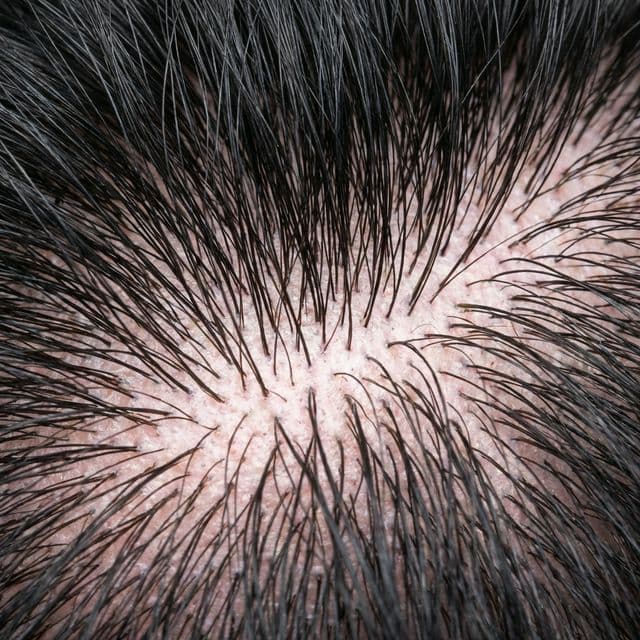
Start with the scalp condition, not a surgery date
If you have scalp psoriasis and are considering a hair transplant, tell the surgeon before booking. The decision needs an assessment of your scalp, the reason for thinning and the treatment you use. A photograph showing a receding hairline does not reveal the full history of flares, soreness or medicines.
Psoriasis-related hair loss is not automatically permanent hair loss. The American Academy of Dermatology explains that hair may grow again after scalp psoriasis clears. This means that treating the scalp and reassessing the thinning can be an important step before deciding that follicles need to be moved. AAD hair-loss diagnosis and treatment guidance.
There is no single online rule that can tell everyone with psoriasis to proceed or never proceed. The useful question is whether a particular operation is appropriate for your current condition. Our hair transplant service information explains the general assessment route; make your psoriasis history part of that assessment from the beginning.
Hair thinning and scalp psoriasis may be separate problems
Someone with psoriasis can still have another reason for hair loss. A thinning crown or receding front may need a different explanation from hair coming away when scales are scratched. It is therefore useful to describe the pattern and timing rather than attributing every change to the diagnosis you already know.
Tell the doctor whether thinning began before the psoriasis, during a flare or after a change in treatment. Explain whether the same area remains thin even when the scalp feels comfortable. Bring photographs from periods when symptoms were better as well as pictures taken during a flare.
The consultation should clarify what the proposed transplant would actually treat. If the answer is permanent pattern hair loss, ask how that conclusion was reached. If the cause remains uncertain, a cosmetic estimate should not be mistaken for diagnostic confirmation.
A practical way to frame the discussion is to ask for two statements: the current scalp diagnosis, and the current explanation for the visible hair loss. They may be related, but they are not necessarily identical. Understanding both helps you make sense of why medical treatment, observation or surgery is being recommended.
Why active symptoms should be discussed before surgery
Itching, thick scale, soreness and repeated scratching make scalp care more difficult. The AAD advises gentle management of scalp psoriasis and warns against forceful removal of scale because it can pull out hair. It also recommends discussing persistent symptoms with the treating clinician. AAD advice on reducing hair loss with scalp psoriasis.
Do not hide a flare because you are worried that the operation will be postponed. Send a current description or photograph to the clinic if symptoms change after your consultation. Explain what you are applying and whether the skin is broken, tender or unusually irritated.
A postponement may be inconvenient, especially after arranging leave or travel, but the medical team needs an accurate picture. The relevant question is what needs to improve or be clarified before a decision is made. Ask for that explanation rather than accepting either an unexplained refusal or an unexplained reassurance.
You should not be expected to diagnose whether a new sore or discharge is psoriasis. If there is increasing pain, pus, fever, spreading redness or another unexpected change, seek medical advice promptly. A known skin diagnosis does not mean every new symptom has the same cause.
Skin injury can matter in psoriasis
Psoriasis can sometimes appear or flare at sites of skin injury, a response known as the Koebner phenomenon. The AAD discusses this link between injury and psoriasis flares. AAD explanation of injury-related flares.
A hair transplant involves small wounds. It is therefore reasonable to ask the dermatologist and surgeon to consider your history of psoriasis after cuts, scratching, tattoos or other skin procedures. This is a clinical inference from the injury response, not a claim that every patient will flare after transplantation or that an exact personal risk can be calculated online.
If you have had a previous operation, describe what happened around the wound rather than simply saying it healed normally. Were there new plaques, prolonged irritation or a change in treatment? If nothing unusual occurred, that is useful history too, but it is not a guarantee about another procedure.
Ask what the team would do if scalp symptoms returned after surgery. The plan should explain who would assess the problem and how the dermatologist and surgeon would coordinate care. A generic instruction sheet should not be the only answer to a condition-specific concern raised before the operation.
Review all psoriasis treatment with the doctors
Bring the names and doses of prescribed tablets, injections, creams, lotions and shampoos. Include when each was last used and which clinician prescribed it. Do not rely on the colour of the bottle or a description such as “the strong medicine”. Photographing the label can help if the product name is difficult to remember.
Ask the surgeon whether any part of the treatment requires discussion with your dermatologist. Do not stop a systemic medicine, biologic injection or topical prescription on your own to make the scalp look ready for surgery. Equally, do not apply an extra course because someone online says it prevents a flare.
The decision about continuing, adjusting or pausing treatment belongs to the clinicians who understand both the skin disease and the proposed operation. A useful written plan names who is responsible for each instruction and what to do if advice from different clinics appears to conflict.
Include ordinary products as well. Hair dye, oils, cosmetic fibres and styling products may be part of your routine, and irritation can make the story harder to interpret. This does not mean every product is a problem. It means the team should know what is being used before suggesting changes.
What does “controlled psoriasis” mean for this decision?
Patients are often told that the scalp must be controlled without being told what that means. Ask the treating team to describe the findings they want to see and how they will reassess them. A day when the scalp looks less flaky is not necessarily the same as a completed medical evaluation.
Useful questions include whether the planned treatment area has active symptoms, whether the current diagnosis is clear and whether your routine is manageable. Ask whether another examination is needed close to the proposed procedure date and what changes should trigger an earlier call.
Avoid adopting a fixed number of symptom-free days from another patient's story. There is no universal clearance interval offered by the sources cited here for hair transplantation in psoriasis. The relevant decision is individual, and the team should explain its reasoning rather than present an arbitrary countdown as a guarantee.
If your symptoms vary, a short record can be helpful. Note when flares occur, what treatment was being used and any practical difficulty with the routine. The goal is to improve the history available to the doctor, not to create a daily score that you must interpret yourself.
Give hair recovery a fair assessment
Once the scalp is treated, ask how the hair itself will be reviewed. A comfortable scalp and improved density are different outcomes and may be judged at different times. You may need a follow-up specifically to decide how much persistent thinning remains.
Use comparable photographs if your clinician recommends them. Keep hair reasonably similar in length and position, with similar lighting and dryness. A bright ceiling light on wet hair can make a later photograph look worse even when the comparison is not meaningful.
Do not assume that every visible gap needs a transplant while medical treatment is still being assessed. Conversely, do not assume that all thinning will disappear merely because the psoriasis settles. The point of reassessment is to distinguish what changed from what persists.
Ask the doctor to describe the next decision in advance. For example, will persistent thinning prompt further diagnostic review, discussion of treatment for another cause, or a surgical assessment? Knowing the decision point helps avoid moving straight from one paid treatment to another without understanding the reason.
If surgery is considered appropriate
A suitable candidate needs healthy hair that can be moved and a recipient area capable of supporting growth. The AAD describes examination as central to this decision and notes that expectations must be realistic. AAD guidance on hair transplant candidacy.
For someone with psoriasis, the consultation should connect the general transplant plan with the scalp history. Ask why surgery is being recommended now, which problem it will improve and what uncertainty remains. The answer should go beyond the name of the implantation method.
Discuss what would cause the team to postpone or revise the plan. Ask whether the surgeon has reviewed your dermatologist's advice and whether you need to bring any recent treatment records. Ensure you know which clinician to contact for a flare before the procedure.
The result should be a clear, practical pathway rather than a promise that controlling psoriasis removes every surgical risk. Ask for ordinary consent information as well, including scarring, infection, bleeding and the possibility of disappointing growth. The NHS hair transplant page explains these general risks; it is not specific clearance for surgery with psoriasis.
Planning scalp care without conflicting instructions
Before proceeding, ask how your established scalp-care routine will fit with the surgeon's instructions. You should not be left to choose between two contradictory sheets after a procedure. The team can explain which products are appropriate at each stage and who will handle questions about psoriasis treatment.
Write down the actual product names and the instruction attached to each one. If advice changes, ask for the updated plan in writing. This is especially useful when you see more than one clinician or when a family member helps with care.
Do not assume that a product sold for dandruff is interchangeable with your prescription. Do not use another patient's post-operative schedule as a replacement for the plan made for you. The task is to coordinate care for your scalp, not to assemble a routine from separate internet suggestions.
If you will be travelling, explain where you will be staying and how follow-up will happen. A person with a known tendency to scalp symptoms should understand how to obtain assessment if something changes, rather than relying only on reassurance that an online photograph will always be enough.
Questions to bring to your consultation
A short written list can keep the conversation focused:
- What is causing the hair loss, and is it separate from the psoriasis?
- Does the current scalp condition need treatment before a transplant decision?
- What would make you postpone the procedure?
- How will my existing psoriasis medicines be reviewed?
- What is the significance of my history of flares after skin injury?
- Who will manage a flare if one occurs around the procedure?
- What improvement is realistic after the scalp has been reassessed?
You can also state the outcome that matters most to you. Wanting relief from an itchy scalp is a different goal from wanting a fuller frontal hairline. If both matter, put both on the list so that a surgical discussion does not crowd out the symptom that affects your daily life most.
Frequently asked questions
Does scalp psoriasis always rule out a hair transplant?
An online article cannot give universal clearance or refusal. The clinician needs to assess the psoriasis, the cause of thinning, treatment history and the proposed procedure. Active symptoms or diagnostic uncertainty may change the plan.
Should I stop my psoriasis medicine before the consultation?
Do not stop a prescribed medicine on your own. Bring the treatment details and let the dermatologist and surgeon coordinate any changes needed for a proposed procedure.
Will all the thinning disappear when the psoriasis improves?
Not necessarily. Some loss may improve, but another cause of thinning can coexist. Reassessment helps clarify what remains before surgery is considered.
A sensible next step
Scalp psoriasis should be part of the transplant decision from the outset. Establish the cause of thinning, manage the scalp condition and review the response before making a permanent cosmetic plan. A careful assessment may lead to surgery, postponement, another treatment or advice against surgery.
For an individual review, begin with our hair transplant assessment information and bring your psoriasis treatment history. The aim is a decision that makes sense for both your scalp health and your appearance goals, with clear ownership of care if symptoms change.