Quick answer
A no-shave hair transplant can be worth considering in Hyderabad if keeping your appearance discreet is important and your hair-loss pattern can be treated safely without a full shave. It is not a separate miracle technique, and it is not automatically better than standard FUE. In most cases, “no-shave” describes how the donor and recipient hair are prepared, while FUE describes how follicular units are extracted and placed.
The right choice depends on four things: how many grafts you need, how much donor hair you have, whether the recipient area is stable, and how much short-term visibility you can accept. No-shave work may reduce the obvious sign that a procedure has happened, but it can take longer, cost more, and may not be suitable for a large session or advanced baldness.
If you are comparing a quote in Hyderabad, ask whether the plan is truly unshaven, partially shaved, or simply marketed as “DHI,” who performs the extraction and implantation, how many grafts are recommended, and what happens if your existing hair continues to thin.
What does “no-shave hair transplant” actually mean?
In a conventional FUE hair transplant, the donor area at the back and sides of the scalp is usually trimmed short so the surgeon can see the angle and direction of each follicular unit. The recipient area may also be trimmed, depending on the extent of thinning and the surgeon’s preference.
A no-shave or unshaven transplant keeps some or all of the visible hair at its existing length. There are several versions:
- Fully unshaven FUE: the donor and recipient hair are kept long, although small areas may still be trimmed or hidden.
- Partial-shave FUE: only a narrow strip or selected donor zones are shortened and covered by the surrounding hair.
- Unshaven recipient placement: the donor is trimmed for extraction, but grafts are placed between existing recipient hairs without shaving the thinning area.
- No-shave DHI: a marketing term often used when grafts are inserted with an implanter. It does not, by itself, prove that the procedure is fully unshaven or that it will deliver a better result.
The exact definition matters because “no shave” can mean different things from one clinic to another. Before booking, request a written explanation of which areas will be trimmed, how many grafts can be safely harvested, and whether the quoted price changes for an unshaven session.
No-shave FUE vs standard FUE: the practical comparison
Visibility during the first week
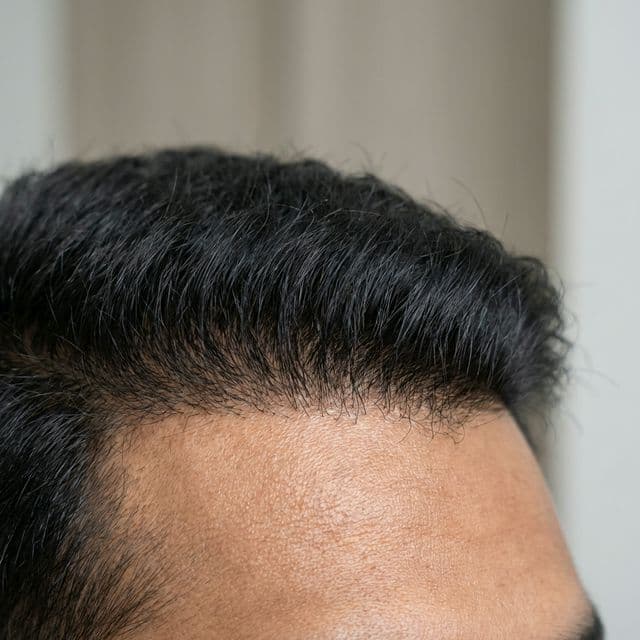
The main advantage of no-shave FUE is concealment. Existing hair can cover small crusts, redness, and the short donor zone, which may be useful for someone with a public-facing role, upcoming event, or limited ability to explain a visible procedure.
Standard FUE is more obvious initially because the donor hair is short. However, the shorter field gives the surgical team a clearer view. Washing, examining, and photographing the healing area are usually simpler, and the early appearance may be more predictable.
Neither option makes the recovery invisible. The recipient area can still show tiny crusts, swelling, redness, or implanted grafts. A patient who expects to look completely unchanged the next morning may be disappointed with either technique.
Graft capacity and treatment area
No-shave sessions are generally best for a small to moderate number of grafts, such as a focused hairline refinement, temple correction, or limited crown work. Long hair makes it harder to identify, extract, sort, and place grafts efficiently. Hair can tangle, obscure the direction of growth, and increase the time required for each step.
Standard FUE is usually more practical when the treatment needs a larger graft count or covers several zones. A full shave provides better visibility of the donor area and helps the surgeon maintain consistent spacing, protect the safe donor zone, and design the recipient sites accurately.
A bigger graft count is not automatically a better plan. Overharvesting a donor area to chase density can create visible thinning later. The goal should be a natural hairline and a sensible distribution of limited donor follicles, not the largest number written on a quotation.
Surgical precision
FUE is a technique, not a guarantee of quality. The outcome depends on diagnosis, hairline design, graft selection, extraction angles, graft handling, recipient-site planning, implantation direction, and long-term medical management.
Standard FUE can offer excellent precision because the field is easier to see. No-shave FUE can also be precise in experienced hands, but the work is technically more demanding. The presence of long hair should never force a surgeon to compromise the donor pattern or place grafts into an unstable area.
The relevant question is not “Which label is best?” It is “Which preparation allows the surgeon to perform the safest, most natural plan for my pattern of loss?”
Comfort, time, and recovery
The basic recovery principles are similar because follicles still need to be extracted and placed. Both procedures can involve temporary swelling, tightness, mild soreness, crusting, and a period in which newly implanted hairs shed before regrowth begins.
No-shave sessions often take longer. Longer operating time may mean more fatigue for the patient and team, and it can affect the total fee. Standard FUE is usually easier to clean and monitor during the first few days because the scalp is accessible.
Recovery is not determined by the haircut alone. It depends more on the number of grafts, the size of the treated area, your skin response, aftercare, smoking or nicotine exposure, medical conditions, and whether the recipient area contains vulnerable existing hairs.
Cost in Hyderabad
There is no single fixed “no-shave hair transplant cost in Hyderabad.” A responsible quote is built from the diagnosis, graft requirement, technique, surgeon involvement, facility, anaesthesia or sedation plan, medicines, follow-up, and the complexity of keeping hair unshaven.
No-shave procedures may cost more than a comparable standard FUE session because they require additional time, careful handling, and a narrower working field. DHI or implanter-assisted placement may also carry a premium, but the device name should not replace a clear explanation of who performs each stage.
When comparing quotes, check whether the number refers to grafts or hairs. One graft may contain one, two, three, or more hairs, so “3,000 hairs” is not the same as “3,000 grafts.” Ask for:
- The estimated graft count and the expected number of hairs.
- A map showing the proposed hairline and recipient zones.
- The planned donor area and the maximum safe harvest.
- The parts of the procedure performed personally by the surgeon.
- Whether medicines, follow-ups, and any recommended PRP sessions are included.
- A plan for ongoing hair loss in non-transplanted areas.
The cheapest quote can become expensive if it leads to an unnatural hairline, depleted donor area, or need for corrective surgery.
Who is a good candidate for no-shave FUE?
No-shave FUE may suit you if:
- You have early or moderate pattern hair loss and need a focused session.
- You have enough existing hair to conceal the donor and recipient areas.
- You understand that small trims may still be needed.
- Your hair loss has been assessed and the proposed recipient area is stable enough.
- You value discretion and accept a longer procedure or higher fee.
- You can follow aftercare carefully even when long hair makes the scalp harder to see.
It may be less suitable when the bald area is extensive, the required graft count is high, the donor hair is weak or diffuse, or the scalp needs to be fully visible for safe planning. It may also be a poor choice for someone with rapidly progressing loss who has not yet discussed medical stabilisation.
A proper consultation should assess the pattern of hair loss, scalp health, donor density, hair calibre, family history, age, previous procedures, and expectations. A transplant moves existing follicles; it does not stop future miniaturisation in untreated hair.
When standard FUE is the better choice
Standard FUE is often the more sensible option when safety, visibility, and efficiency matter more than concealment. A full or partial shave can help with:
- Accurate donor mapping and even extraction.
- Larger graft sessions.
- Consistent recipient-site design.
- Easier hygiene and follow-up examinations.
- Better visibility of the direction and spacing of existing hair.
- A shorter operating time in suitable cases.
Choosing standard FUE is not “settling” for an inferior procedure. For many patients, it is the approach that gives the surgeon the clearest view and the best ability to use the donor supply responsibly.
A surgeon may recommend a partial shave as a compromise. This can preserve the appearance of longer hair while creating a controlled working area. The best preparation is the one that protects the quality of the operation, not necessarily the one with the most appealing name.
Can no-shave FUE give the same results?
It can, in appropriately selected patients, but the technique alone does not determine the result. Natural-looking restoration depends on a hairline that suits your age and facial proportions, grafts placed at the correct angle, appropriate density, good graft survival, and a plan for future loss.
Hair growth is gradual. Transplanted hairs commonly shed during the early healing phase before new growth develops. Visible improvement often takes several months, while the final assessment is usually made around 9 to 12 months, depending on the patient and the area treated. Crown restoration can take longer to look full because of the whorl pattern and the larger surface area involved.
Be cautious with promises of instant density, guaranteed survival, or a permanent result without discussing progressive hair loss. A surgeon should show you what the plan is designed to achieve and what it cannot change.
Questions to ask at your Hyderabad consultation
Bring the same questions to every clinic so you can compare plans rather than slogans:
About diagnosis
- What is the likely cause and pattern of my hair loss?
- Is the loss stable, or should I first consider medical treatment?
- Is the donor area strong enough for the density I want?
- Do I need any blood tests or scalp evaluation before surgery?
About the proposed procedure
- Is this fully unshaven, partially shaved, or standard FUE?
- Which areas will be trimmed, and how long will the hair need to be?
- How many grafts are recommended, and why?
- Who designs the hairline, extracts the grafts, creates recipient sites, and implants them?
- What is the plan if more grafts are needed in the future?
About the result and recovery
- What will I look like at 7 days, 1 month, 3 months, and 12 months?
- How long should I avoid gym workouts, swimming, helmets, and direct sun?
- When can I return to work and social activities?
- What follow-up is included, and how are complications handled?
A good consultation should leave you with a reasoned plan, not pressure to book immediately.
Frequently Asked Questions
Is no-shave hair transplant really scarless?
FUE uses small punch openings rather than a linear strip scar, but “scarless” is not a medically accurate promise. Tiny dot scars can remain in the donor area, and their visibility depends on punch size, extraction pattern, healing, hair length, and individual scarring response.
Is DHI better than FUE?
DHI usually refers to a way of placing grafts with an implanter, while FUE refers mainly to how grafts are extracted. They are not always mutually exclusive. DHI is not automatically better; the diagnosis, surgeon’s planning, graft handling, and patient selection are more important than the label.
Can I go to work immediately after a no-shave transplant?
Some patients return to desk work after a few days, but it depends on the graft count, swelling, redness, crusting, and the visibility your job allows. No-shave preparation may make the procedure less obvious, but it does not eliminate healing signs.
Is no-shave FUE more painful?
Pain is usually managed with local anaesthesia during the procedure and prescribed medication afterward. Discomfort varies by patient and by the extent of the session. The fact that the hair is not shaved does not necessarily make the procedure more or less painful.
How long do transplanted hairs last?
Follicles taken from a genetically more resistant donor zone can provide long-lasting growth, but the result is not a guarantee against all future hair loss. The non-transplanted hair can continue to thin, which is why diagnosis and an appropriate maintenance plan matter.
Is no-shave FUE suitable for women?
It can be suitable for selected women, especially when a focused area needs restoration and preserving existing hair is important. Female hair loss has multiple causes, including diffuse patterns and medical conditions, so the diagnosis must come before the procedure.
Practical takeaway
If keeping your hair long during recovery is a high priority and you need a focused restoration, no-shave FUE may be a useful option in Hyderabad. If you need a large number of grafts, have advanced thinning, or want the clearest surgical field, standard or partially shaved FUE may be safer and more predictable.
Compare plans by diagnosis, donor-area protection, graft count, surgeon involvement, realistic recovery, and long-term strategy. Book a consultation with Dr. Dushyanth Kalva at Inform Clinic to understand which preparation and technique fit your pattern of hair loss, rather than choosing a procedure because its marketing label sounds more advanced.