Quick Answer
Female hair loss is far more common than most women realise and far less openly discussed than male hair loss. In India, a combination of nutritional deficiencies, hormonal factors, stress, and genetic predisposition makes female hair thinning one of the most frequently encountered concerns at hair restoration clinics. The good news is that the majority of women with hair loss have treatable underlying causes — and identifying the correct cause is the essential first step. Treatment without diagnosis wastes time and money. The right treatment, applied at the right stage, produces meaningful results.
Why Female Hair Loss Is Different from Male Hair Loss
Male and female hair loss differ in cause, pattern, progression, and treatment. The distinction matters because what works for men may not be appropriate for women, and the diagnosis process is different.
In men, androgenetic alopecia (male pattern hair loss) is the dominant cause in the vast majority of cases — driven by DHT sensitivity in genetically predetermined follicles, producing a predictable recession of the hairline and crown thinning that follows the Norwood scale.
In women, the picture is significantly more complex. Female hair loss can be:
- Androgenetic (female pattern hair loss) — the most common type, but presenting differently from men
- Telogen effluvium — diffuse shedding triggered by systemic stress, nutritional deficiency, illness, or hormonal change
- Alopecia areata — autoimmune patchy hair loss
- Traction alopecia — mechanical damage from hairstyling practices
- Scarring alopecias — rare but important to identify as they permanently destroy follicles
- Thyroid or endocrine disorders presenting as hair loss
- Iron deficiency anaemia — among the most common reversible causes in Indian women
Multiple causes can coexist in the same patient. A woman may have underlying genetic predisposition, triggered and accelerated by post-pregnancy telogen effluvium, exacerbated by iron deficiency. Treating only one cause without addressing the others produces incomplete results.
How Female Pattern Hair Loss (Androgenetic Alopecia) Presents
Female androgenetic alopecia does not cause a receding hairline in the way male pattern baldness does. Instead, it presents as:
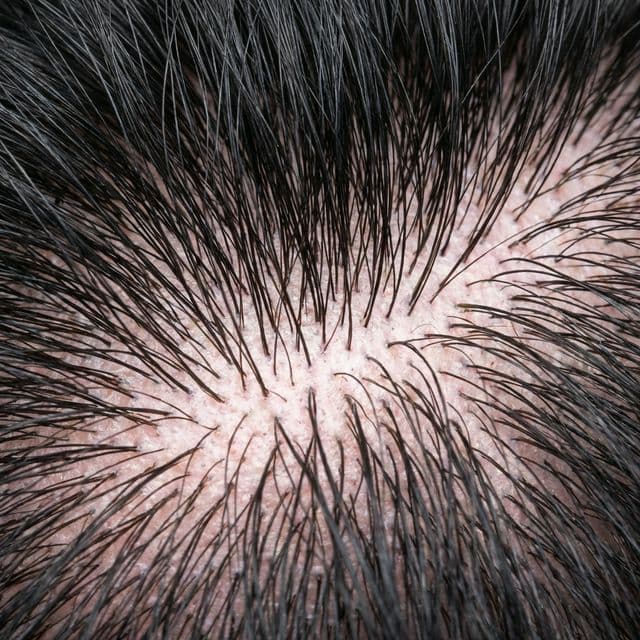
Diffuse thinning of the crown and mid-scalp — the frontal hairline is typically preserved. Women notice the central parting becoming wider, or that the scalp becomes visible through the hair on top of the head.
The Ludwig scale classifies female androgenetic alopecia into three grades:
- Grade I: Mild widening of the central part; early loss of density on top of the scalp
- Grade II: More pronounced widening of the part; visible scalp through the central and mid-scalp region
- Grade III: Significant diffuse thinning over the top of the head; near-complete loss of density on the crown while the hairline remains
The key feature is that follicles in female androgenetic alopecia are miniaturised — they shrink progressively but remain present. This means early intervention can slow or partially reverse the process. Completely bald areas in women with androgenetic alopecia are less common than in men, which also means the donor supply for transplantation is less impacted.
Telogen Effluvium — The Most Common Acute Hair Loss in Women
Telogen effluvium is diffuse, non-patterned hair shedding that occurs when a large proportion of follicles simultaneously shift from the growth phase (anagen) to the resting/shedding phase (telogen). This produces a dramatic increase in daily hair fall — handfuls in the shower, on the pillow, on hairbrushes — that is alarming but in most cases self-limiting.
Common triggers in Indian women:
- Post-pregnancy (postpartum telogen effluvium) — very common, typically starting 2–3 months after delivery and resolving by 6–12 months
- Significant weight loss, particularly rapid weight loss or crash dieting
- Iron deficiency anaemia — extremely common in Indian women due to dietary patterns and menstrual blood loss
- Thyroid dysfunction — both hypothyroidism and hyperthyroidism can cause telogen effluvium
- Severe illness, surgery, or hospitalisation
- Significant psychological stress
- Nutritional deficiencies — vitamin D, B12, ferritin, zinc
- Starting or stopping hormonal contraceptives
The critical distinction: telogen effluvium is usually reversible when the trigger is identified and corrected. The hair that has entered telogen will shed over 3–6 months, then regrow over the following 6–12 months as follicles re-enter anagen. The problem is when telogen effluvium is superimposed on underlying androgenetic alopecia — the shedding reveals miniaturised follicles that were already present, and the hair that returns is thinner than what was lost.
Diagnosing Female Hair Loss Correctly
Accurate diagnosis requires a systematic approach. At Inform Clinic, Dr. Dushyanth Kalva's assessment of female hair loss includes:
Clinical History
- Duration and onset of hair loss — sudden (suggests telogen effluvium) vs gradual (suggests androgenetic alopecia)
- Pattern of loss — diffuse vs localised vs hairline
- Associated symptoms — fatigue, weight changes, menstrual irregularity, skin or nail changes
- Recent triggers — pregnancy, illness, dietary changes, medications
- Family history — both maternal and paternal hair loss history
- Current medications, supplements, and contraceptive method
- Hair care practices — heat styling, chemical treatments, tight hairstyles
Blood Tests
A minimum panel for female hair loss should include:
- Full blood count with differential (anaemia, infection)
- Serum ferritin (iron stores — the most sensitive marker; serum iron alone is insufficient)
- Thyroid function tests (TSH, T3, T4)
- Vitamin D (25-OH)
- Vitamin B12
- Zinc
- Hormonal panel if androgen excess is suspected — testosterone, DHEAS, SHBG, prolactin
- Random blood glucose / HbA1c if metabolic syndrome is a concern
In India specifically, iron deficiency and vitamin D deficiency are the two most commonly missed reversible causes of female hair loss. Many women are treated for presumed androgenetic alopecia when addressing ferritin levels alone resolves the majority of their shedding.
Scalp Examination and Dermoscopy
Dermoscopy (handheld magnification of the scalp surface) allows assessment of follicle diameter, miniaturisation pattern, scalp inflammation, and follicular unit structure. It can differentiate androgenetic alopecia (variable diameter follicles, thin vellus hairs alongside normal hairs) from telogen effluvium (normal follicle size but reduced density), alopecia areata (yellow dots, broken hairs), and scarring alopecias (loss of follicular ostia).
This examination significantly improves diagnostic accuracy compared to clinical assessment alone.
Medical Treatments for Female Hair Loss
Minoxidil
Minoxidil is the best-established medical treatment for female androgenetic alopecia. Available as a topical solution (2% or 5%) or oral (low-dose). It works by prolonging the anagen (growth) phase and increasing follicle size. It does not address the hormonal cause of androgenetic alopecia but consistently slows progression and improves density in most women who use it consistently.
Key facts about minoxidil for women:
- Results take 4–6 months to become visible
- Must be used continuously — stopping causes the improved hair to shed over 3–6 months as follicles return to their pre-treatment state
- 5% topical and low-dose oral (0.625–2.5mg daily) are now commonly used; the evidence for oral minoxidil in women is growing significantly
- Side effects in women include rare hypertrichosis (unwanted hair growth on face or body) — more common with the 5% solution; lower concentrations and oral low-dose reduce this risk
- Not suitable during pregnancy or breastfeeding
Anti-Androgens (Spironolactone, Finasteride)
In women with androgenetic alopecia, anti-androgenic medications can reduce the hormonal stimulus driving follicle miniaturisation. Spironolactone (50–200mg daily) is commonly used in premenopausal women. Finasteride is used in post-menopausal women only due to its teratogenic risk in women of childbearing age. Both require monitoring and are prescription medications.
Results with anti-androgens are modest but meaningful — they slow progression and, in some patients, produce moderate regrowth when combined with minoxidil.
Nutritional Correction
Where deficiencies are identified, correction is not optional — it is the primary treatment. Iron supplementation in iron-deficient women can significantly reduce shedding and improve hair quality over 3–6 months. Vitamin D, B12, and zinc supplementation similarly address their specific deficiency states.
The response to nutritional correction is often underestimated. Many women who come to hair clinics expecting surgical intervention find that correcting their ferritin levels resolves most of their complaint.
Platelet-Rich Plasma (PRP)
PRP injections stimulate follicle activity through growth factor delivery. In women with androgenetic alopecia and residual miniaturised follicles, PRP produces measurable improvement in hair density and shaft diameter over a series of 3–6 sessions. It is most effective when:
- Combined with medical treatment (minoxidil, correction of deficiencies)
- Used in early-to-moderate stages where active miniaturised follicles remain
- Maintained with sessions every 4–6 months after the initial course
PRP is not a replacement for medical treatment and does not restore hair in areas where follicles are permanently lost. It is a useful adjunct in the overall management of female androgenetic alopecia.
Traction Alopecia — A Preventable Cause
Traction alopecia is hair loss caused by sustained mechanical tension on the follicles from hairstyling practices. In Indian women, common causes include:
- Tight braids or plaits pulled from the hairline
- High ponytails or buns worn daily with significant tension
- Hair extensions or weaves attached under tension to natural hair
- Tight threading or rubber band hair ties applied close to the scalp
The pattern is characteristic: hair loss at the hairline, temples, and along the part — typically in the areas where the tension is greatest. Early traction alopecia is reversible when the causative practice is stopped. Longstanding traction alopecia can cause permanent follicle destruction and scarring, at which point regrowth is not possible.
The critical advice: if a hairstyle is painful at the roots, it is damaging the follicles. Pain is an early warning sign that should not be ignored or tolerated.
When Is a Hair Transplant Appropriate for Women?
Hair transplantation is a legitimate treatment option for carefully selected women with hair loss — but the selection criteria differ significantly from men, and inappropriate transplantation in women produces poor results.
Women who may be good candidates for hair transplantation:
- Those with stable androgenetic alopecia and a well-defined area of permanent loss, with adequate donor density in the back and sides of the scalp
- Women with traction alopecia causing permanent hairline recession where follicles are irreversibly destroyed
- Post-surgical or post-traumatic scarring with hair loss in a localised area
- Women who have been on appropriate medical treatment for at least 12 months without adequate response
Women who are NOT good candidates:
- Those with active, progressive, diffuse androgenetic alopecia — the donor area may itself be thinning, and transplanting into a progressing recipient area means the grafts will be surrounded by increasingly thin hair
- Women with telogen effluvium that has not yet resolved — transplanting into an unstable scalp is inappropriate
- Those with alopecia areata — an autoimmune condition that may affect transplanted grafts as well
- Women with diffuse unpatterned alopecia (DUPA) — a form of androgenetic alopecia affecting the donor area as well as the recipient, making transplantation unreliable
The most important step before any consideration of transplantation in a woman is a full assessment of donor area health — including dermoscopy to confirm that the donor zone follicles are not themselves miniaturising.
Questions Women Commonly Ask
Will my hair grow back on its own?
If the cause is telogen effluvium from a reversible trigger (postpartum, nutritional deficiency, stress-related), then yes — hair typically regrows over 6–12 months once the trigger is addressed. If the cause is androgenetic alopecia, the hair will not regrow without treatment, but progression can be slowed and some improvement in density achieved with appropriate medical treatment.
How long before I see results from treatment?
Hair growth is slow. Any treatment — whether medical or procedural — takes a minimum of 3–4 months to produce visible results because the hair growth cycle is 3–4 months long. Most patients begin to see meaningful improvement at 6 months of consistent treatment. Full assessment of a treatment response should not be made before 12 months.
Is it stress causing my hair loss?
Psychological stress can trigger telogen effluvium, but stress alone rarely causes significant hair loss without a pre-existing vulnerability (nutritional deficiency, androgenetic predisposition). More commonly, patients attribute hair loss to stress when the actual cause is nutritional or hormonal — and correcting those factors produces improvement even without resolving the stress.
Should I change my shampoo or use hair oils?
Shampoos and topical hair oils have minimal impact on hair loss caused by internal factors. There is no shampoo that reverses androgenetic alopecia or telogen effluvium. Scalp hygiene is important — a clean, healthy scalp is a better environment for follicles — but the marketing claims of most hair loss shampoos significantly exceed their evidence base.
Getting the Right Diagnosis in Hyderabad
The most important message in this guide is that female hair loss requires diagnosis before treatment. Empirical treatment without understanding the cause is inefficient and often ineffective. At Inform Clinic in Hyderabad, Dr. Dushyanth Kalva approaches female hair loss with a structured diagnostic assessment — blood panel, scalp dermoscopy, and clinical history — before recommending any treatment.
If you have been experiencing hair loss, shedding, or thinning in Hyderabad and want a clear answer about what is causing it and what can be done, a consultation at Inform Clinic is the right starting point.